Aaron Meisner, Chairman of Stop Slots Maryland, promised a group of MoCo activists today that his organization would wage an aggressive campaign to defeat the slots referendum. What is his plan and will it work?
Meisner made his remarks at a public meeting of Progressive Neighbors, a liberal group based in Silver Spring and Takoma Park. He started by noting that most recent slots referenda have failed, a point previously demonstrated by Free State Politics blogger Eric Luedtke. So while slots have a 60%+ favorability in Maryland polls, victory is possible.
"We can win, but it won't be easy," Meisner said. "It's not easy to transform a grass-roots lobbying organizations into a statewide campaign. It's taking time to shift gears." Meisner indicated that the organization is recruiting political operators with statewide campaign experience in Maryland and is in heavy talks with several religious groups. He described the evolving coalition as a group of "strange bedfellows" including secular progressives, rural values voters and religious organizations. "It's a big challenge to get organized," he admitted.
Meisner did not get into specifics, but upon reading a hard copy of this blog post, he indicated that the new plan would resemble what we have outlined. Overall it seems that Stop Slots Maryland is just getting moving. As he says, they have a real challenge: radically changing the organization in the midst of waging its most critical and difficult campaign yet. It is very, very tough for any organization to change so much while on the move, but that is what has to happen for them to win.
Right now, the big questions on this issue are:
1. Will the Governor campaign in favor of the referendum?
2. How will Stop Slots Maryland raise the money needed to win?
3. How will the organization liaison with the street-level activists who will be critical to victory?
Elbridge James, President of Progressive Maryland, hinted at the answer to a fourth big question at the same meeting. When asked whether Progressive Maryland would "help lead the fight against slots," James said that the issue would be decided at a board meeting of the group in late January. "The question is will we oppose slots vigorously, oppose slots passively or not oppose them," he said. While James declined to provide a hard prediction of what Progressive Maryland would do, few of us left the meeting believing that the group would fight hard against slots. Several of the group's union affiliates may in fact support slots because of hopes to unionize casino workers, perform the construction work, or gain more public funding. This creates a significant possibility that Progressive Maryland will sit out this fight, thus lessening the chances of slots opponents.
Pay attention to this one, folks. The fighters are still in their robes, bouncing in their corners. Michael Buffer is only now reaching for the mike. I'd advise you to place your bets, but ah... maybe that's the wrong metaphor.
Sunday, January 13, 2008

Friday, January 11, 2008
Reflecting on Wheaton
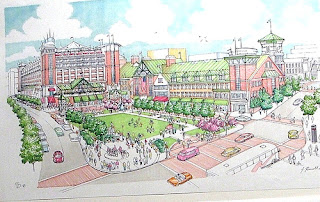
Could Wheaton look like this someday?
So why have we been talking about Wheaton? After all, this blog is called Maryland Politics Watch, not Wheaton Watch. There are two reasons.
First, Holly Olson, author of the prior three postings, is my long-suffering wife. To get a sense of that suffering, imagine having to hear maximum-volume rantings about such things as the Baroness of Montgomery 24-7. One reason I blog is because she ordered me to “get it out of your system.” The least I can do is return the favor and give her a conduit for expressing her thoughts, which are infinitely better-formed than mine.
But second, and much more importantly, Wheaton represents the future of Montgomery County, the state of Maryland and the United States. Its bustling, chaotic streets, its teeming masses of every language and color and its combination of private-sector optimism and skepticism of government hearken back to our roots of a century ago. If we can bring Wheaton to its full potential, we will have a formula that could be applied broadly to every main street in America.
For those of you who are unfamiliar with Wheaton, it lies at the junction of three of Montgomery County’s great avenues: Georgia Avenue, University Boulevard and Veirs Mill Road. Along with Silver Spring and Takoma Park, it is one of the county’s three truly diverse urban centers.
Wheaton does not have the prosperity or sheer population size of Silver Spring. It does not have the municipal government of Takoma Park. But it does have a friendly, welcoming spirit along with astounding diversity. In one small shopping center along University Boulevard, two Jewish food establishments co-exist with a Thai grocery, a Chinese restaurant and a Pho kitchen. Right across the street are a couple Latino restaurants. An Italian pizza joint is on the next block up and a Korean restaurant is around the corner. At several Wheaton businesses, when the owner hears I have walked in, he comes out, slaps me on the back and asks if my wife (who is invariably present) has gotten rid of me yet. (She usually answers, “First he buys me lunch.”) Unfortunately, Sabang was one of those places.
But Wheaton has its problems. Holly discussed the economic ones. In addition, I see a more basic one: the difficulty of communication and building relationships within the community. I worked with Holly and the Latino Economic Development Corporation (LEDC) on the inspiring parking meter revolt of last summer. One of our strategies was distributing 3,000 handbills to business owners protesting the new hours, which they could then give to their customers. Now I’ve spent many years in the labor movement, so cold calls are no big deal to me. But Wheaton was a different experience. In some of these businesses, the music was blaring and bodies were flying. Others were barren and empty. Many, many languages were spoken. Many workers looked at me with a stare that said, “Are you here from the government to mess with us?” In some places, I could not identify the manager or owner. All of this causes me to have immense sympathy for the employees of the county’s Mid-County Regional Services Center who have to deal with all of these establishments.
This polyglot of polysyllables extends to the organizations in Wheaton. There are three county advisory committees with jurisdiction in Wheaton. There are several civic associations who are inside and nearby. There is both a Wheaton-Kensington Chamber of Commerce and a new association for local, small businesses being created by LEDC. There is also the management of Westfield Wheaton, the giant mall just outside the central business district. There is one county services center, but its brave, overworked staff faces the daunting task of dealing with all of the above as well as similar issues in many other areas outside Wheaton. The central communication challenge for politicians and outsiders is that while many people speak for a part of Wheaton, no one speaks for all of Wheaton.
But we are going to have to resolve that problem because Wheaton is changing, and not necessarily for the better. Holly discussed the continuing exodus of many long-time businesses due to rising rents. Many believe that redevelopment is necessary, and the county has long recognized its need. In 2006, County Council Members Marilyn Praisner and Tom Perez championed a new zoning text amendment that raised allowable building heights and relaxed obstacles to building improvements in the central business district, all while encouraging small square footages in new retail spaces. To date, not a single new development has taken advantage of the opportunities in this new amendment.
Instead, the market seems to be creating two Wheatons. On the outskirts of the CBD, high-end housing projects have been sprouting like gilded mushrooms, including a new one above the eastern Metro entrance. Until the recent housing crash, some of the new townhouses were selling for over $600,000. But inside the CBD, there’s not much going on. One low-rise project is under construction at Georgia and University, but it has failed to maximize its location’s potential and will have little impact on the district’s retail capacity. And as Holly has said, businesses are leaving. It seems that Wheaton has two possible paths before it: continued bifurcation or a general decline along the lines of Langley Park.
It doesn’t have to be that way. Wheaton is the last great opportunity for revitalization among the county’s four downtowns. It has Metro access and bus access. It has one of the area’s most diverse stocks of retail and restaurants. A few years ago, local residents worked with the county government to produce a vision of what a revitalized CBD could look like, and that concept appears at the beginning of this post. Here’s another view:
 The left edge of the “V” is Veirs Mill Road. The right edge is Georgia Avenue. Tucked into the middle is a broad swath of green space. On all sides is a mix of retail and residential, anchored by a parking garage topped by residences just north of the central green. Here is a central community space that’s greener than Silver Spring, friendly to pedestrians and features a built-in customer base for business through integrated residential in the core.
What about the existing businesses? Preventing further exodus is a high priority for both Wheaton’s business community and its devoted customers (including this author). How about getting the developers to build retail condos, grandfathering the existing businesses as owners and subsidizing their condo mortgages? Come on, guys, this is MoCo. We’re smart, we care and we’ve got resources, so we can get this done.
But somehow, the above vision has been lost in the bureaucratic shuffle and Wheaton is starting over – again. Just as in the past, resources are being directed elsewhere, a situation exacerbated by a tight budget. Businesses continue to feel disconnected from the government and some are leaving. Residents continue to wonder what, if anything, is happening. And rumor has it that the county is coming up with a new “theme” for Wheaton. Why does it have to be re-invented again? When will we stop planning and start doing? What are we waiting for?
The future of Wheaton, and the future of America, await.
Wednesday, January 9, 2008
Power to the People
Part Three of a Three-Part Series by Holly Olson. (View Parts One and Two.)
In Part Two of my post on Wheaton, I was perhaps a little hard on our County Executive. It is not my intent to make him out to be the bad guy, but I do believe that we all need a little tough love every so often to get our butts in gear. And since I am an equal opportunity distributor of tough love, I feel that I must now turn my attention to the Wheaton community.
If there is one truth in politics, it is this: politicians pay attention to you if you make some noise. What do I mean by noise? Noise can take a lot of forms. It can be subtle (political contributions), it can be loud (letters, emails, public testimony), or it can be electoral (voting for candidates based on whether they support your issue).
Wheaton does many things well, but the one thing that the community does not do so well is MAKE SOME NOISE. Does this mean that there are no activists? No civic associations? No business groups? Absolutely not. In fact, many of them are vocal in sharing their concerns about Wheaton. But too often this takes place on a singular level. They do not speak with a united voice, and therefore they lack power. But when Wheaton does speak with a unified voice, the impact can be significant. I offer the following story to illustrate my point.
This past summer, the County was going to extend parking meter hours in the urban district parking lots. Businesses in all the affected urban districts were understandably upset. Downtown Silver Spring launched a massive campaign to get this reversed. And, lo and behold, Ike Leggett was listening. In fact, he listened so well to Silver Spring that he was going to reverse the hours for Silver Spring but not for Wheaton.
Given how precarious the businesses climate was for many of our restaurants, a group of us in Wheaton realized that we could not let this happen. We could not, and should not, be at a competitive disadvantage with other areas in the county. So, at the urging of County Council Member Valerie Ervin and with the help of the non-profit group LEDC, we created our own anti-parking meter campaign. Together, we launched an on-line petition. We canvassed business owners and encouraged them to write to the politicians. We gave them 3,000 flyers to give to their customers so that they could write as well. We solicited letters from community associations. We had a block of people testify before the county council: business owners, non-profits, citizen associations, and activists alike. In short, we ran a multi-faceted campaign to let the politicians know that we were not going to take this.
When we first launched the campaign, there was a sense of resignation among the business community. They had been so used to just taking whatever the County dished out that they felt like there was nothing that they could do that would make a difference. But gradually, that changed. And for the first time since I have been active in the Wheaton community, I saw hope in the faces of business owners. They began to realize that their actions did matter, and that they could make a difference. Why? Because they were united, they spoke with one voice, and they mounted an aggressive campaign to fight back. I share this story because I truly believe that more of this type of action needs to take place in Wheaton. Not just within the business community, but all facets of the community.
As we speak, there are efforts underway to do just that. The Latino Economic Development Corporation (LEDC), a non-profit that provides technical assistance, training, and financing in the area is working with Wheaton business owners to launch a Wheaton Small Business Alliance. The goal of this group is to advocate and support local businesses while promoting the principles of diversity and economic and environmental sustainability. This is an important first step because it seeks to unite the business community, which has long been fragmented. If this is successful, I believe it will serve as a catalyst for other such efforts to give a voice to Wheaton.
In the end, the bottom line is this. If the Wheaton community wants to be a political priority in Montgomery County, they must unite and pursue their interests more aggressively. There must be constant pressure. They must demand to be treated with the same respect as other urban districts such as Bethesda and Silver Spring, and they must hold their politicians accountable when they do not. The only ones that can fight for Wheaton are the community itself — therein lies the power of the people.
Holly Olson is the former Chair of the Wheaton Redevelopment Advisory Committee.
In Part Two of my post on Wheaton, I was perhaps a little hard on our County Executive. It is not my intent to make him out to be the bad guy, but I do believe that we all need a little tough love every so often to get our butts in gear. And since I am an equal opportunity distributor of tough love, I feel that I must now turn my attention to the Wheaton community.
If there is one truth in politics, it is this: politicians pay attention to you if you make some noise. What do I mean by noise? Noise can take a lot of forms. It can be subtle (political contributions), it can be loud (letters, emails, public testimony), or it can be electoral (voting for candidates based on whether they support your issue).
Wheaton does many things well, but the one thing that the community does not do so well is MAKE SOME NOISE. Does this mean that there are no activists? No civic associations? No business groups? Absolutely not. In fact, many of them are vocal in sharing their concerns about Wheaton. But too often this takes place on a singular level. They do not speak with a united voice, and therefore they lack power. But when Wheaton does speak with a unified voice, the impact can be significant. I offer the following story to illustrate my point.
This past summer, the County was going to extend parking meter hours in the urban district parking lots. Businesses in all the affected urban districts were understandably upset. Downtown Silver Spring launched a massive campaign to get this reversed. And, lo and behold, Ike Leggett was listening. In fact, he listened so well to Silver Spring that he was going to reverse the hours for Silver Spring but not for Wheaton.
Given how precarious the businesses climate was for many of our restaurants, a group of us in Wheaton realized that we could not let this happen. We could not, and should not, be at a competitive disadvantage with other areas in the county. So, at the urging of County Council Member Valerie Ervin and with the help of the non-profit group LEDC, we created our own anti-parking meter campaign. Together, we launched an on-line petition. We canvassed business owners and encouraged them to write to the politicians. We gave them 3,000 flyers to give to their customers so that they could write as well. We solicited letters from community associations. We had a block of people testify before the county council: business owners, non-profits, citizen associations, and activists alike. In short, we ran a multi-faceted campaign to let the politicians know that we were not going to take this.
When we first launched the campaign, there was a sense of resignation among the business community. They had been so used to just taking whatever the County dished out that they felt like there was nothing that they could do that would make a difference. But gradually, that changed. And for the first time since I have been active in the Wheaton community, I saw hope in the faces of business owners. They began to realize that their actions did matter, and that they could make a difference. Why? Because they were united, they spoke with one voice, and they mounted an aggressive campaign to fight back. I share this story because I truly believe that more of this type of action needs to take place in Wheaton. Not just within the business community, but all facets of the community.
As we speak, there are efforts underway to do just that. The Latino Economic Development Corporation (LEDC), a non-profit that provides technical assistance, training, and financing in the area is working with Wheaton business owners to launch a Wheaton Small Business Alliance. The goal of this group is to advocate and support local businesses while promoting the principles of diversity and economic and environmental sustainability. This is an important first step because it seeks to unite the business community, which has long been fragmented. If this is successful, I believe it will serve as a catalyst for other such efforts to give a voice to Wheaton.
In the end, the bottom line is this. If the Wheaton community wants to be a political priority in Montgomery County, they must unite and pursue their interests more aggressively. There must be constant pressure. They must demand to be treated with the same respect as other urban districts such as Bethesda and Silver Spring, and they must hold their politicians accountable when they do not. The only ones that can fight for Wheaton are the community itself — therein lies the power of the people.
Holly Olson is the former Chair of the Wheaton Redevelopment Advisory Committee.
Monday, January 7, 2008
Where is the Love for Wheaton?
Part Two of a Three-Part Series by Holly Olson. (View Part One here.)
While serving on the Wheaton Redevelopment Advisory Committee for three years, I had the opportunity to talk to a number of residents and business owners about redevelopment issues. A typical conversation would usually begin with me relaying the recent news about redevelopment and discussing some of the options we saw for the future.
It was at this point, that if I happened to be talking with someone who was a long-time resident, the following would inevitably happen. Their eyes would kind of take on this soft, pitying look that seemed to say, you seem like a nice girl, and we appreciate you telling us this, but we’ve been around for awhile. And then they would say, “Yes, but they have been telling us Wheaton would redevelop for the last 10+ years, and it hasn’t happened yet.” It was never said with meanness, simply resignation.
This reaction was so prevalent that I took to calling it the F squared factor: fatigue and frustration. Fatigue comes from having been told for many years that redevelopment is right around the corner. “Just be patient,” the community is told. “Redevelopment is coming. Things will get better.” They have heard this for so long and seen so few results that it no longer means anything to them. It is simply an empty promise. Frustration comes from the fact that they are seeing millions of dollars being pumped into the revitalization efforts of other communities in the County, while Wheaton considers itself lucky to get a few crumbs.
In many ways, Wheaton is an oxymoron. It is an urban center located on a metro stop. It is a diverse community with tremendous spirit. By all accounts Wheaton should be serving as a national model for redevelopment — incorporating the principles of smart growth, economic and environmental sustainability, and demographic diversity. And yet it doesn’t. Instead it just sits.
Ok, you say — but it hasn’t been all gloom and doom. There has been some progress. True enough. But given the economy over the last 10 years, the demand for housing, and the increased energy directed towards revitalizing older urban centers, the pace of redevelopment has been snail-like. Wheaton has faced an uphill battle in many ways including an outdated sector plan, and up until recently, zoning within the urban core that was less than conducive for development.
Development hang-ups due to technical issues such as zoning and sector plans are important and should not be underestimated. However, one of the major factors I see in the lack of redevelopment is that Wheaton is simply not a priority for many of our politicians. In particular, Wheaton seems to have gotten little play with our County Executive. On occasion, I hear statements indicating that the County Executive is committed to Wheaton. But I don’t see that in his actions. Instead, what I see is that he continues to pump millions of dollars into Silver Spring (most recently evident in his deal to bring in Live Nation) while Wheaton continues to receive very little.
As the County faces a looming budget crisis, it is naïve to think that Wheaton will be getting any deals of its own this year. But what I do hope is that the County Executive will make some concrete and tangible efforts towards helping the Wheaton redevelopment effort. Perhaps even that is too much to ask in this environment. But the community needs hope. They need to know that their County Council and the County Executive care about them and are committed to the future of Wheaton.
So, I ask you, County Executive Leggett, “Do you have love for Wheaton?”
Holly Olson is the former Chair of the Wheaton Redevelopment Advisory Committee.
While serving on the Wheaton Redevelopment Advisory Committee for three years, I had the opportunity to talk to a number of residents and business owners about redevelopment issues. A typical conversation would usually begin with me relaying the recent news about redevelopment and discussing some of the options we saw for the future.
It was at this point, that if I happened to be talking with someone who was a long-time resident, the following would inevitably happen. Their eyes would kind of take on this soft, pitying look that seemed to say, you seem like a nice girl, and we appreciate you telling us this, but we’ve been around for awhile. And then they would say, “Yes, but they have been telling us Wheaton would redevelop for the last 10+ years, and it hasn’t happened yet.” It was never said with meanness, simply resignation.
This reaction was so prevalent that I took to calling it the F squared factor: fatigue and frustration. Fatigue comes from having been told for many years that redevelopment is right around the corner. “Just be patient,” the community is told. “Redevelopment is coming. Things will get better.” They have heard this for so long and seen so few results that it no longer means anything to them. It is simply an empty promise. Frustration comes from the fact that they are seeing millions of dollars being pumped into the revitalization efforts of other communities in the County, while Wheaton considers itself lucky to get a few crumbs.
In many ways, Wheaton is an oxymoron. It is an urban center located on a metro stop. It is a diverse community with tremendous spirit. By all accounts Wheaton should be serving as a national model for redevelopment — incorporating the principles of smart growth, economic and environmental sustainability, and demographic diversity. And yet it doesn’t. Instead it just sits.
Ok, you say — but it hasn’t been all gloom and doom. There has been some progress. True enough. But given the economy over the last 10 years, the demand for housing, and the increased energy directed towards revitalizing older urban centers, the pace of redevelopment has been snail-like. Wheaton has faced an uphill battle in many ways including an outdated sector plan, and up until recently, zoning within the urban core that was less than conducive for development.
Development hang-ups due to technical issues such as zoning and sector plans are important and should not be underestimated. However, one of the major factors I see in the lack of redevelopment is that Wheaton is simply not a priority for many of our politicians. In particular, Wheaton seems to have gotten little play with our County Executive. On occasion, I hear statements indicating that the County Executive is committed to Wheaton. But I don’t see that in his actions. Instead, what I see is that he continues to pump millions of dollars into Silver Spring (most recently evident in his deal to bring in Live Nation) while Wheaton continues to receive very little.
As the County faces a looming budget crisis, it is naïve to think that Wheaton will be getting any deals of its own this year. But what I do hope is that the County Executive will make some concrete and tangible efforts towards helping the Wheaton redevelopment effort. Perhaps even that is too much to ask in this environment. But the community needs hope. They need to know that their County Council and the County Executive care about them and are committed to the future of Wheaton.
So, I ask you, County Executive Leggett, “Do you have love for Wheaton?”
Holly Olson is the former Chair of the Wheaton Redevelopment Advisory Committee.
Sunday, January 6, 2008
George McGovern Calls for Impeachment
Former Senator and Democratic Presidential candidate George McGovern called for President Bush's impeachment this morning. His column in the Washington Post is a must-read.
There are many reasons for not impeaching the President: it's too late, people don't want it, the Republicans will block it, Cheney will assume the office, etc. But McGovern, a winner of the Distinguished Flying Cross during World War II, makes the best case for it of any that I have read.
He thunders, "Bush and Cheney are clearly guilty of numerous impeachable offenses. They have repeatedly violated the Constitution. They have transgressed national and international law. They have lied to the American people time after time. Their conduct and their barbaric policies have reduced our beloved country to a historic low in the eyes of people around the world. These are truly 'high crimes and misdemeanors,' to use the constitutional standard." McGovern goes on to list the intentional lies on Iraq and Iran, the criminal negligence in New Orleans and the blatantly illegal wiretapping of American citizens as specific grounds for removal.
And then he predicted that, at age 85, he would not be around to witness the rebuilding of our country. That is a sad statement because McGovern helped to build our country's greatness throughout his entire life - a greatness that the current President has done everything in his power to destroy.
I have never been a big proponent of impeachment because I know the Democrats do not have the votes to remove President Bush. But when one of our most honest and principled national heroes calls for it in his final hours, we should at least have a vote.
There are many reasons for not impeaching the President: it's too late, people don't want it, the Republicans will block it, Cheney will assume the office, etc. But McGovern, a winner of the Distinguished Flying Cross during World War II, makes the best case for it of any that I have read.
He thunders, "Bush and Cheney are clearly guilty of numerous impeachable offenses. They have repeatedly violated the Constitution. They have transgressed national and international law. They have lied to the American people time after time. Their conduct and their barbaric policies have reduced our beloved country to a historic low in the eyes of people around the world. These are truly 'high crimes and misdemeanors,' to use the constitutional standard." McGovern goes on to list the intentional lies on Iraq and Iran, the criminal negligence in New Orleans and the blatantly illegal wiretapping of American citizens as specific grounds for removal.
And then he predicted that, at age 85, he would not be around to witness the rebuilding of our country. That is a sad statement because McGovern helped to build our country's greatness throughout his entire life - a greatness that the current President has done everything in his power to destroy.
I have never been a big proponent of impeachment because I know the Democrats do not have the votes to remove President Bush. But when one of our most honest and principled national heroes calls for it in his final hours, we should at least have a vote.
Thursday, January 3, 2008
Wheaton, We (May) Have a Problem…
Part One of a Three-Part Series by Holly Olson.
The Wheaton community suffered another loss recently when restaurant owner Victor Lantang closed his Indonesian restaurant, Sabang. If you never had an opportunity to visit Sabang, I can tell you that you missed out. They had one of the best lunch buffets in town.
The closing of Sabang comes on the heels of two other Wheaton businesses closing their doors: Bonifant, a used bookstore, and Barnaby’s Sports Pub and Restaurant. What these three businesses all had in common was that they were long-time members of the Wheaton community.
The fact that businesses close is nothing new. Costs have been increasing and rents in the Wheaton area have been rising — perhaps at a rate higher than justified by the market. And, as re-development in Wheaton continues (albeit slowly), many business owners will have to either adapt or will themselves close. This is part of change and a reality that we all must face.
However, for three long-time businesses to have closed in such a short time period is worrisome. Yes, the vast majority of small businesses are still operating, but how many have to close or relocate before this becomes a trend? When does it become a problem? Personally, I would rather err on the side of caution and hope that the county would be as proactive as possible in terms of providing assistance to our small business owners. So what should the County be doing to help them?
My sense is that the County actually does a pretty good job in terms of providing services. There are in fact, lots of services available — everything from technical assistance to loans. The deficiencies in Wheaton seem to exist more in the area of outreach. Therefore, I have laid out five outreach components that I believe are essential for helping Wheaton small businesses survive.
1. Develop relationships with the business owners.
Let me blunt about this: Many Wheaton business owners do not trust the County. Period. The only way to gain that trust back is to develop a positive working relationship with them. They need to know that the County is there for them and that they have someone that they can go to – whether it is about the latest redevelopment “gossip” or to discuss resources for training assistance.
2. Anticipate the needs of the businesses
Even organizations with the best of intentions can misconstrue the needs of their customers. By building relationships with business owners, the County will be able to better anticipate their needs. So, instead of the County providing businesses with what they think they need, they can provide them with what they actually need.
3. Recognize Wheaton’s diversity
Wheaton has tremendous diversity in terms of the demographic composition of its owners and the types of businesses available. Demographically, it means that there will be language and cultural differences that the County will need to account for. In terms of businesses, it means that the County can not just focus on one type of business, such as restaurants, but all types of businesses.
4. Partner with external organizations
The bottom-line is that the County simply does not posses the resources to be everything to every one of the small businesses. To be so would be incredibly inefficient and a waste of taxpayer money. That is why it is essential that the County continue to partner with organizations such as Latino Economic Development Corporation (LEDC) to help fill in the gaps. LEDC is a non-profit organization that provides technical assistance, training, and financing to small business owners. Although fairly new to Wheaton, they have already provided a number of micro-loans to area businesses and have been essential in conducting outreach to many of Wheaton’s ethnic business owners.
5. Communicate, communicate, communicate
This is perhaps the area that the County needs to work on the most. Despite the multitude of services available, most business owners don’t know they exist. In addition, like any small community, rumors abound among business owners—particularly about redevelopment. Many of these rumors are false and often involve some variant of a business getting kicked out for the sake of redevelopment. This creates a sense of paranoia and distrust among the business owners. To effectively communicate, the County needs to do so through a variety of modes: internet, email, hard-copy flyers and newsletters, seminars, town halls, and in-person visits. When businesses are well-informed, they will feel more confident that the County has their back.
Some of what I have just discussed is already taking place through the Wheaton redevelopment office. But this office does not have the resources to handle all of the above work alone. For this effort to truly be successful, it will take a commitment from the County and resources from all facets of the County government.
Holly Olson is the former Chair of the Wheaton Redevelopment Advisory Committee.
The Wheaton community suffered another loss recently when restaurant owner Victor Lantang closed his Indonesian restaurant, Sabang. If you never had an opportunity to visit Sabang, I can tell you that you missed out. They had one of the best lunch buffets in town.
The closing of Sabang comes on the heels of two other Wheaton businesses closing their doors: Bonifant, a used bookstore, and Barnaby’s Sports Pub and Restaurant. What these three businesses all had in common was that they were long-time members of the Wheaton community.
The fact that businesses close is nothing new. Costs have been increasing and rents in the Wheaton area have been rising — perhaps at a rate higher than justified by the market. And, as re-development in Wheaton continues (albeit slowly), many business owners will have to either adapt or will themselves close. This is part of change and a reality that we all must face.
However, for three long-time businesses to have closed in such a short time period is worrisome. Yes, the vast majority of small businesses are still operating, but how many have to close or relocate before this becomes a trend? When does it become a problem? Personally, I would rather err on the side of caution and hope that the county would be as proactive as possible in terms of providing assistance to our small business owners. So what should the County be doing to help them?
My sense is that the County actually does a pretty good job in terms of providing services. There are in fact, lots of services available — everything from technical assistance to loans. The deficiencies in Wheaton seem to exist more in the area of outreach. Therefore, I have laid out five outreach components that I believe are essential for helping Wheaton small businesses survive.
1. Develop relationships with the business owners.
Let me blunt about this: Many Wheaton business owners do not trust the County. Period. The only way to gain that trust back is to develop a positive working relationship with them. They need to know that the County is there for them and that they have someone that they can go to – whether it is about the latest redevelopment “gossip” or to discuss resources for training assistance.
2. Anticipate the needs of the businesses
Even organizations with the best of intentions can misconstrue the needs of their customers. By building relationships with business owners, the County will be able to better anticipate their needs. So, instead of the County providing businesses with what they think they need, they can provide them with what they actually need.
3. Recognize Wheaton’s diversity
Wheaton has tremendous diversity in terms of the demographic composition of its owners and the types of businesses available. Demographically, it means that there will be language and cultural differences that the County will need to account for. In terms of businesses, it means that the County can not just focus on one type of business, such as restaurants, but all types of businesses.
4. Partner with external organizations
The bottom-line is that the County simply does not posses the resources to be everything to every one of the small businesses. To be so would be incredibly inefficient and a waste of taxpayer money. That is why it is essential that the County continue to partner with organizations such as Latino Economic Development Corporation (LEDC) to help fill in the gaps. LEDC is a non-profit organization that provides technical assistance, training, and financing to small business owners. Although fairly new to Wheaton, they have already provided a number of micro-loans to area businesses and have been essential in conducting outreach to many of Wheaton’s ethnic business owners.
5. Communicate, communicate, communicate
This is perhaps the area that the County needs to work on the most. Despite the multitude of services available, most business owners don’t know they exist. In addition, like any small community, rumors abound among business owners—particularly about redevelopment. Many of these rumors are false and often involve some variant of a business getting kicked out for the sake of redevelopment. This creates a sense of paranoia and distrust among the business owners. To effectively communicate, the County needs to do so through a variety of modes: internet, email, hard-copy flyers and newsletters, seminars, town halls, and in-person visits. When businesses are well-informed, they will feel more confident that the County has their back.
Some of what I have just discussed is already taking place through the Wheaton redevelopment office. But this office does not have the resources to handle all of the above work alone. For this effort to truly be successful, it will take a commitment from the County and resources from all facets of the County government.
Holly Olson is the former Chair of the Wheaton Redevelopment Advisory Committee.
Tuesday, January 1, 2008
How to Beat Slots
Failing to pass an outright bill after many years of debate, the Maryland legislature has sent the slots issue to the voters. Next November, the issue will finally be decided by referendum. Sixty-eight percent of Maryland residents supported slots in a recent Washington Post poll and the gambling industry is set to pour millions into a pro-slots advertising campaign. So the Free State will soon see beeping machines entitled “Mike Miller’s Mega-Bucks” and “O’Malley’s O’Millions,” right?
Wrong.
As Eric Luedtke points out on Free State Politics, the gambling industry has won only 5 of 16 ballots since 2004, and only 2 of 6 ballots since 2006. Past experience shows that it is possible to defeat the gambling industry even when they start out with a lead in the polls. But it will take disciplined organization, cooperation among unlikely allies, a bit of money and unprecedented volunteer efforts to get the job done.
There are three constituencies that oppose slots, each for different reasons. None of them has a great deal of experience in working with the others. They are:
Secular Progressives
These individuals are Democratic activists who are social and economic liberals and have contributed money and time to past liberal campaigns. They live disproportionately in Montgomery and Prince George’s Counties but play important roles in many local Democratic Parties across the state. They oppose slots because they view them as regressive and inherently promoting corruption (especially via political contributions). They would play an important role in any pro-slots coalition, but they are insufficient in numbers to win a referendum by themselves. (The recent special session showed the limits of their power as Montgomery County’s delegation expended their political capital on limiting income tax increases on the rich – hardly a liberal priority.)
Religious Groups
Religious groups oppose slots because they see them as morally wrong. In their view, slots promote crime, vice, addiction and a general decline in the culture. Importantly, religious organizations from all parts of the political spectrum – from the most liberal to the most conservative – detest slots. While secular progressives have occasionally worked with liberal religious groups, they have often been on the opposite side of conservative groups. (See Montgomery County’s recent debate on protections for transgender people.)
Neighbors of Slots Sites
Slots are scheduled to be located at five sites: Worcester County on the Eastern Shore (probably the Ocean Downs race track), Anne Arundel County (probably at Laurel Park race track), an unspecified site in Baltimore City, Allegany County (probably at the state-owned Rocky Gap Lodge), and an unspecified site in Cecil County in the northeastern corner of the state. Many leaders in those areas, including the mayor of Ocean City and the Anne Arundel County Executive, oppose slots. It is reasonable to believe that immediate neighbors of the sites would oppose traffic-generating, crime-creating casinos near their homes. Many residents in these areas are probably Republicans. Some may not be regular voters. But since they are now in the target sites of the gambling industry they may be ready and willing to fight back.
None of these groups can defeat organized gambling alone. But if they unite and focus on their common enemy, they can triumph.
In order to win, these groups must work cooperatively inside a campaign structure set up for the express purpose of winning the referendum. That structure does not currently exist and must be created as soon as possible. It is not enough to simply expand Stop Slots Maryland, the group that has resisted slots up to now. That group has engaged successfully in legislative lobbying, but that is a fundamentally different task than grass-roots organizing. A winning structure would bear a significant resemblance to a Presidential state organization. It must have coordinating leadership but also significant local, perhaps even precinct-level, autonomy. It must give local volunteers the guidance, resources, money and expertise to enable them to wage effective house-to-house campaigns in their own neighborhoods. The gambling industry has outspent anti-gambling activists by seven-to-one in prior campaigns, so the anti-slots forces can only win through organized people power.
Here is what a winning anti-gambling coalition looks like:
State Leadership
The state leadership’s primary functions are to raise money, coordinate (but not control) local activities, supply resources (including training), deal with state-level media and run the campaign’s primary website. The state leadership will not directly control strategy on the ground – that is the domain of legislative district captains.
The state leadership committee should be composed of no more than a dozen prominent anti-slots leaders, possibly supplemented by a broader committee for symbolic value. Each of the three constituent groups must be represented. It is vitally important that none of the three constituencies be relegated to second-class status; otherwise it will lose interest in the campaign. It is also important that the state leadership not be too closely identified with any single politician. If it is, it will succumb to geographic, political and personal rivalries. After all, these are politicians we’re talking about.
The state leadership committee should consider hiring an experienced political organizer as an executive director with a monthly salary plus expenses. This individual will be extremely busy managing the website, directing cash flow, placating occasionally jealous politicians, traveling across the state and otherwise keeping the campaign on track.
The most important task of the state leadership is to raise money. In the 2006 gambling campaigns in Arkansas, Nebraska, Ohio, Rhode Island and South Dakota, the Baltimore Sun reported that a total $54 million was raised by both sides. The gambling industry accounted for 90% of this total. Applying these figures to Maryland on a per capita basis, the Free State’s anti-slots activists would need to raise $1.7 million to match the record of the other campaigns. A quick way to begin would be to ask every anti-slots politician in the state to contribute $4,000 from his or her campaign account. If 50 politicians heed this request, the state leadership would have $200,000 which could immediately be applied to raising more money from the public. An additional benefit would be to identify which politicians were truly anti-slots, thereby revealing others who were anti-slots in their rhetoric but unwilling to back it up with their own campaign funds.
The campaign website is a critical gateway to potential volunteers. It must contain extensive FAQs on the issue, identify supportive leaders, allow monetary contributions (including through credit cards), contain printable handbills and other literature, report news items and most importantly, connect the visitor to their relevant district captains. Each district captain should have his or her own web page through which to communicate about local activities. It is very important that the website not only inform and persuade, but also give the visitor the motivation and tools to become an activist in his or her own area.
Each of the individual state leaders should also tend to their own constituencies. A politician from Montgomery County, for example, could activate his or her own network of campaign volunteers for anti-slots activities. A church leader could initiate talks with nearby religious groups. A conservative leader could seek out resources from national conservative groups that oppose gambling. Each of them could initiate media coverage from local newspapers. The important thing is that these efforts should be coordinated with ground-level activities through district captains as well as with other state leaders. And each must focus on opposition to gambling as opposed to other elements of their agendas – an easier task to describe than accomplish.
District Captains
W. Minor Carter, a lobbyist for Stop Slots Maryland, recently told the Baltimore Sun, “We need a lot of little heroes.” Carter is correct. Anti-slots activists are more motivated and more numerous than pro-slots activists (if there are any), but they must be organized for success. This is the critical task of the district captains, each of whom is selected by the state leadership to manage grass-roots efforts in one of the state’s 47 legislative districts.
The district captains will identify and enroll activists, create and schedule work assignments, and implement locality-specific activities designed to educate voters and turn out the anti-slots vote at referendum time. Each will use a page from the statewide website to provide contact info to prospective activists, announce work assignments and other events, and exchange info with volunteers through attached listservs. District captains will apply to state leadership for literature, access to politicians, local leaders and other resources, and general guidance. But actual work decisions will be made by the captains and their teams and must be customized to local circumstances. For example, a district captain in a heavily Latino area may want to distribute Spanish-language literature. Another district captain near a proposed slots site may want to saturate neighborhoods within a two-mile radius. Yet another district captain may want to forge a close alliance with a locally-prominent religious organization. These decisions cannot be dictated by Annapolis.
While the state leadership should not micromanage the district captains, it is vitally important that they provide the captains with training. Soon after the captains’ selection, the state leadership should arrange a training session in grass-roots organizing provided by experienced political campaign operators. Literature drops, housecalls, training volunteers, scheduling assignments, media relations and other common campaign activities should all be covered extensively. Follow-up sessions, including joint briefings and info exchanges, should occur regularly over the course of the campaign.
Religious groups may want to set up parallel structures because congregations often cross district and county lines. Some may want to produce customized literature reflecting the priorities of their congregations. Others may want to work with closely allied non-profits. Still others may want to bring in assistance from national organizations. These decisions are best left to religious leaders but should be communicated to relevant district captains. On a campaign involving this many different groups in so many spheres of influence, communication by itself will be a significant challenge.
Measurement and Accountability
The state leadership committee and the executive director must strike an appropriate balance between respecting local autonomy and demanding results. Promulgating a measurement system at the start of the campaign would make clear the expectations of district captains – perhaps the sole part of the campaign’s structure under the discretion of the state leadership. Possible measures include number of handbills distributed, number of volunteers coordinated, and number of man-hours worked. Some underperforming district captains may need to be replaced, especially if they fail to produce significant numbers in a jurisdiction with potential (such as Ocean City or Montgomery County). Other district captains may need to be supplemented with aid from nearby jurisdictions. While the district captains should have lots of leeway in deciding how to meet performance measures, the state leadership is responsible for ensuring that those measures are actually realized.
Maryland has rarely seen a grass-roots issue operation of the nature described above. But anti-slots activists need one now. The clock is ticking. Gambling corporations and their allies are already raising money, reserving ad time, filming commercials and printing direct-mail pieces. If the opponents want to maximize their chances for success, the time for counterattack is now.
Wrong.
As Eric Luedtke points out on Free State Politics, the gambling industry has won only 5 of 16 ballots since 2004, and only 2 of 6 ballots since 2006. Past experience shows that it is possible to defeat the gambling industry even when they start out with a lead in the polls. But it will take disciplined organization, cooperation among unlikely allies, a bit of money and unprecedented volunteer efforts to get the job done.
There are three constituencies that oppose slots, each for different reasons. None of them has a great deal of experience in working with the others. They are:
Secular Progressives
These individuals are Democratic activists who are social and economic liberals and have contributed money and time to past liberal campaigns. They live disproportionately in Montgomery and Prince George’s Counties but play important roles in many local Democratic Parties across the state. They oppose slots because they view them as regressive and inherently promoting corruption (especially via political contributions). They would play an important role in any pro-slots coalition, but they are insufficient in numbers to win a referendum by themselves. (The recent special session showed the limits of their power as Montgomery County’s delegation expended their political capital on limiting income tax increases on the rich – hardly a liberal priority.)
Religious Groups
Religious groups oppose slots because they see them as morally wrong. In their view, slots promote crime, vice, addiction and a general decline in the culture. Importantly, religious organizations from all parts of the political spectrum – from the most liberal to the most conservative – detest slots. While secular progressives have occasionally worked with liberal religious groups, they have often been on the opposite side of conservative groups. (See Montgomery County’s recent debate on protections for transgender people.)
Neighbors of Slots Sites
Slots are scheduled to be located at five sites: Worcester County on the Eastern Shore (probably the Ocean Downs race track), Anne Arundel County (probably at Laurel Park race track), an unspecified site in Baltimore City, Allegany County (probably at the state-owned Rocky Gap Lodge), and an unspecified site in Cecil County in the northeastern corner of the state. Many leaders in those areas, including the mayor of Ocean City and the Anne Arundel County Executive, oppose slots. It is reasonable to believe that immediate neighbors of the sites would oppose traffic-generating, crime-creating casinos near their homes. Many residents in these areas are probably Republicans. Some may not be regular voters. But since they are now in the target sites of the gambling industry they may be ready and willing to fight back.
None of these groups can defeat organized gambling alone. But if they unite and focus on their common enemy, they can triumph.
In order to win, these groups must work cooperatively inside a campaign structure set up for the express purpose of winning the referendum. That structure does not currently exist and must be created as soon as possible. It is not enough to simply expand Stop Slots Maryland, the group that has resisted slots up to now. That group has engaged successfully in legislative lobbying, but that is a fundamentally different task than grass-roots organizing. A winning structure would bear a significant resemblance to a Presidential state organization. It must have coordinating leadership but also significant local, perhaps even precinct-level, autonomy. It must give local volunteers the guidance, resources, money and expertise to enable them to wage effective house-to-house campaigns in their own neighborhoods. The gambling industry has outspent anti-gambling activists by seven-to-one in prior campaigns, so the anti-slots forces can only win through organized people power.
Here is what a winning anti-gambling coalition looks like:
State Leadership
The state leadership’s primary functions are to raise money, coordinate (but not control) local activities, supply resources (including training), deal with state-level media and run the campaign’s primary website. The state leadership will not directly control strategy on the ground – that is the domain of legislative district captains.
The state leadership committee should be composed of no more than a dozen prominent anti-slots leaders, possibly supplemented by a broader committee for symbolic value. Each of the three constituent groups must be represented. It is vitally important that none of the three constituencies be relegated to second-class status; otherwise it will lose interest in the campaign. It is also important that the state leadership not be too closely identified with any single politician. If it is, it will succumb to geographic, political and personal rivalries. After all, these are politicians we’re talking about.
The state leadership committee should consider hiring an experienced political organizer as an executive director with a monthly salary plus expenses. This individual will be extremely busy managing the website, directing cash flow, placating occasionally jealous politicians, traveling across the state and otherwise keeping the campaign on track.
The most important task of the state leadership is to raise money. In the 2006 gambling campaigns in Arkansas, Nebraska, Ohio, Rhode Island and South Dakota, the Baltimore Sun reported that a total $54 million was raised by both sides. The gambling industry accounted for 90% of this total. Applying these figures to Maryland on a per capita basis, the Free State’s anti-slots activists would need to raise $1.7 million to match the record of the other campaigns. A quick way to begin would be to ask every anti-slots politician in the state to contribute $4,000 from his or her campaign account. If 50 politicians heed this request, the state leadership would have $200,000 which could immediately be applied to raising more money from the public. An additional benefit would be to identify which politicians were truly anti-slots, thereby revealing others who were anti-slots in their rhetoric but unwilling to back it up with their own campaign funds.
The campaign website is a critical gateway to potential volunteers. It must contain extensive FAQs on the issue, identify supportive leaders, allow monetary contributions (including through credit cards), contain printable handbills and other literature, report news items and most importantly, connect the visitor to their relevant district captains. Each district captain should have his or her own web page through which to communicate about local activities. It is very important that the website not only inform and persuade, but also give the visitor the motivation and tools to become an activist in his or her own area.
Each of the individual state leaders should also tend to their own constituencies. A politician from Montgomery County, for example, could activate his or her own network of campaign volunteers for anti-slots activities. A church leader could initiate talks with nearby religious groups. A conservative leader could seek out resources from national conservative groups that oppose gambling. Each of them could initiate media coverage from local newspapers. The important thing is that these efforts should be coordinated with ground-level activities through district captains as well as with other state leaders. And each must focus on opposition to gambling as opposed to other elements of their agendas – an easier task to describe than accomplish.
District Captains
W. Minor Carter, a lobbyist for Stop Slots Maryland, recently told the Baltimore Sun, “We need a lot of little heroes.” Carter is correct. Anti-slots activists are more motivated and more numerous than pro-slots activists (if there are any), but they must be organized for success. This is the critical task of the district captains, each of whom is selected by the state leadership to manage grass-roots efforts in one of the state’s 47 legislative districts.
The district captains will identify and enroll activists, create and schedule work assignments, and implement locality-specific activities designed to educate voters and turn out the anti-slots vote at referendum time. Each will use a page from the statewide website to provide contact info to prospective activists, announce work assignments and other events, and exchange info with volunteers through attached listservs. District captains will apply to state leadership for literature, access to politicians, local leaders and other resources, and general guidance. But actual work decisions will be made by the captains and their teams and must be customized to local circumstances. For example, a district captain in a heavily Latino area may want to distribute Spanish-language literature. Another district captain near a proposed slots site may want to saturate neighborhoods within a two-mile radius. Yet another district captain may want to forge a close alliance with a locally-prominent religious organization. These decisions cannot be dictated by Annapolis.
While the state leadership should not micromanage the district captains, it is vitally important that they provide the captains with training. Soon after the captains’ selection, the state leadership should arrange a training session in grass-roots organizing provided by experienced political campaign operators. Literature drops, housecalls, training volunteers, scheduling assignments, media relations and other common campaign activities should all be covered extensively. Follow-up sessions, including joint briefings and info exchanges, should occur regularly over the course of the campaign.
Religious groups may want to set up parallel structures because congregations often cross district and county lines. Some may want to produce customized literature reflecting the priorities of their congregations. Others may want to work with closely allied non-profits. Still others may want to bring in assistance from national organizations. These decisions are best left to religious leaders but should be communicated to relevant district captains. On a campaign involving this many different groups in so many spheres of influence, communication by itself will be a significant challenge.
Measurement and Accountability
The state leadership committee and the executive director must strike an appropriate balance between respecting local autonomy and demanding results. Promulgating a measurement system at the start of the campaign would make clear the expectations of district captains – perhaps the sole part of the campaign’s structure under the discretion of the state leadership. Possible measures include number of handbills distributed, number of volunteers coordinated, and number of man-hours worked. Some underperforming district captains may need to be replaced, especially if they fail to produce significant numbers in a jurisdiction with potential (such as Ocean City or Montgomery County). Other district captains may need to be supplemented with aid from nearby jurisdictions. While the district captains should have lots of leeway in deciding how to meet performance measures, the state leadership is responsible for ensuring that those measures are actually realized.
Maryland has rarely seen a grass-roots issue operation of the nature described above. But anti-slots activists need one now. The clock is ticking. Gambling corporations and their allies are already raising money, reserving ad time, filming commercials and printing direct-mail pieces. If the opponents want to maximize their chances for success, the time for counterattack is now.
Friday, December 21, 2007
How MoCo Does Special Elections
Montgomery County Council vacancies are filled by special elections. So why shouldn’t we do the same for state legislator vacancies?
Here’s how the county process works. When a council vacancy occurs, a special election must be held if the vacancy “occurs before December 1 of the year before a year in which a quadrennial state election will be held.” (County code, Chapter 16, Sec. 16-17(a)(4)) So, if a county council member stepped down on 11/30/09, a special election would have to be held. But if a council member stepped down on 12/2/09, the rest of the council would appoint a replacement who would serve out the rest of the term (County charter, Sec. 106).
When a special election is held, it “must be conducted in a manner consistent with provisions of state law that govern special elections to fill vacancies in the office of representative in Congress.” (County code, Chapter 16, Sec. 16-17(c)(1)) The council must adopt a resolution that sets the dates of both the special primary and the special general election.
However, “if the Council vacancy occurs during the period beginning 120 days before the next regular or special primary or general election conducted in the County under state law and ending 40 days before that election, the special primary election provided for by this Section must be held on the same date as the other election. If a second regular or special primary or general election conducted in the County under state law is held more than 30 but less than 60 days after the special primary election referred to in the preceding sentence, the special general election held under this Section must be held on the same date as the second other election.” (County code, Chapter 16, Sec. 16-17(d)(2))
So by using the same dates as other elections, the cost of special elections can be reduced and turnout can be elevated.
The last time a county council vacancy occurred was when District 5 council member Derick Berlage stepped down in June 2002 to become the county’s Planning Chairman. As the date was too late to trigger the special election requirement, the county council appointed Donnell Peterman to serve out the remaining months of Berlage’s term. Peterman was appointed on the condition that he not leverage his appointed incumbency to seek office that year. Peterman honored that commitment in 2002, choosing instead to run (unsuccessfully) for an at-large seat in 2006.
Now doesn’t this sound a lot better than the appointment process for state legislators, which brought us this and this and this?
The excuses for why we should not hold special elections for state vacancies are rapidly disappearing.
Here’s how the county process works. When a council vacancy occurs, a special election must be held if the vacancy “occurs before December 1 of the year before a year in which a quadrennial state election will be held.” (County code, Chapter 16, Sec. 16-17(a)(4)) So, if a county council member stepped down on 11/30/09, a special election would have to be held. But if a council member stepped down on 12/2/09, the rest of the council would appoint a replacement who would serve out the rest of the term (County charter, Sec. 106).
When a special election is held, it “must be conducted in a manner consistent with provisions of state law that govern special elections to fill vacancies in the office of representative in Congress.” (County code, Chapter 16, Sec. 16-17(c)(1)) The council must adopt a resolution that sets the dates of both the special primary and the special general election.
However, “if the Council vacancy occurs during the period beginning 120 days before the next regular or special primary or general election conducted in the County under state law and ending 40 days before that election, the special primary election provided for by this Section must be held on the same date as the other election. If a second regular or special primary or general election conducted in the County under state law is held more than 30 but less than 60 days after the special primary election referred to in the preceding sentence, the special general election held under this Section must be held on the same date as the second other election.” (County code, Chapter 16, Sec. 16-17(d)(2))
So by using the same dates as other elections, the cost of special elections can be reduced and turnout can be elevated.
The last time a county council vacancy occurred was when District 5 council member Derick Berlage stepped down in June 2002 to become the county’s Planning Chairman. As the date was too late to trigger the special election requirement, the county council appointed Donnell Peterman to serve out the remaining months of Berlage’s term. Peterman was appointed on the condition that he not leverage his appointed incumbency to seek office that year. Peterman honored that commitment in 2002, choosing instead to run (unsuccessfully) for an at-large seat in 2006.
Now doesn’t this sound a lot better than the appointment process for state legislators, which brought us this and this and this?
The excuses for why we should not hold special elections for state vacancies are rapidly disappearing.
Wednesday, December 19, 2007
That's Nice, But Where Are You Getting the Money?
Lt. Governor Anthony Brown is promising billions to pay for BRAC projects. But not so fast.
At an event marking the release of Maryland’s Base Realignment and Closure (BRAC) report, Brown announced an ambitious plan to pay billions for education and transportation needs. The money is needed to adjust the state’s infrastructure to accommodate thousands of new jobs created by the military’s shifting of more capacity into Maryland. Brown’s proposal includes $1.6 billion for 26 transportation projects, with half the money due for projects to commence next year.
But wait – where is the money coming from? In the recent special session, the General Assembly turned down a proposal from the Governor to raise the gas tax. Instead, they chose to devote a portion of the sales tax increase to transportation. Of the estimated $400 million in annual funds generated by the legislature, roughly $250 million would go to maintenance of existing capacity. That leaves $150 million for new projects, or about the cost of one interchange project per year. That’s right – one interchange. In the entire state. Per year. That prompted some Montgomery County politicians to float the idea of a local gas tax for transportation.
No one denies Maryland’s transportation needs. The BRAC projects are another addition to a long list including Baltimore’s Red Line, Montgomery County’s Purple Line and Corridor Cities Transitway, and countless much-beloved little projects. But in the aftermath of the special session, the General Assembly may have little appetite for more tax hikes. So where are they getting the money for BRAC?
Transportation funding is a huge budgetary issue that is not going away. Stay tuned.
At an event marking the release of Maryland’s Base Realignment and Closure (BRAC) report, Brown announced an ambitious plan to pay billions for education and transportation needs. The money is needed to adjust the state’s infrastructure to accommodate thousands of new jobs created by the military’s shifting of more capacity into Maryland. Brown’s proposal includes $1.6 billion for 26 transportation projects, with half the money due for projects to commence next year.
But wait – where is the money coming from? In the recent special session, the General Assembly turned down a proposal from the Governor to raise the gas tax. Instead, they chose to devote a portion of the sales tax increase to transportation. Of the estimated $400 million in annual funds generated by the legislature, roughly $250 million would go to maintenance of existing capacity. That leaves $150 million for new projects, or about the cost of one interchange project per year. That’s right – one interchange. In the entire state. Per year. That prompted some Montgomery County politicians to float the idea of a local gas tax for transportation.
No one denies Maryland’s transportation needs. The BRAC projects are another addition to a long list including Baltimore’s Red Line, Montgomery County’s Purple Line and Corridor Cities Transitway, and countless much-beloved little projects. But in the aftermath of the special session, the General Assembly may have little appetite for more tax hikes. So where are they getting the money for BRAC?
Transportation funding is a huge budgetary issue that is not going away. Stay tuned.
Monday, December 17, 2007
Rez-Ticked
What if you could cast one vote for yourself and become a state legislator? And you could do that without having to raise a single dollar or knock on a single door? Would you do it?
That’s what Kirill Reznik did.
Regular readers of this blog are acquainted with the selection process for state legislative vacancies by now. Kevin Gillogly, in his now-legendary “Who the Frick is Bill?” post, described how Kirill Reznik, a Montgomery County Democratic Central Committee (MCDCC) member, cast the deciding vote to make himself District 39’s next state delegate a few months ago. Never mind the fact that his opponent, Hugh Bailey, had earned 1,451 votes from District 39 residents when he ran for an at-large County Council seat the year before. Never mind the fact that Bailey earned 1,451 more votes than Reznik, who had never run for office, ever did. Reznik, as an MCDCC member, was entitled to vote for himself and Bailey, not an MCDCC member, was not. Do you think that Hugh ever had a chance?
Now I’m sure Kirill Reznik kisses babies, loves dogs, eats apple pie, collects Norman Rockwell artwork and buys American. Lots of politicians – and aspiring politicians – do. And he’s not the first Central Committee member to vote for himself. But since he appeared in Kevin’s excellent “Who the Frick is Bill?” piece, he’s the poster child for this column.
Recently, I ran into a man who was an MCDCC member many years ago. He told me, “Back in the old days, there was no Rezniking. We had a rule that MCDCC members could not be appointed as legislators.”
I asked, “What happened to that rule?”
He replied, “It was never written down. It was just the ethics of the time.”
“The ethics of the time.” Sheesh. How quaint. Does this guy still watch black-and-white TV?
I tried to explain this to my neighbors. They just shrugged and said, “Hey, it’s corrupt back-room politics. Of course they’re going to appoint each other. That’s what we expect out of politicians.”
Is this the relationship the MCDCC wants with bucket-carrying, lawn-mower-pushing Democrats? Do you really want us to believe that the only reason you join MCDCC is to sit around, waiting to get lucky for a legislator to leave so you can vote yourself into office? Don’t you want Democratic voters to find out the good things you do and participate in them? What do you know that your “ethics of the time” predecessors did not?
Even though I heckled them with such terms as “Baroness,” I’ll give credit to the MCDCC for some recent improvements to their process. In their latest selection for District 18 delegate, three of them posted their reasons for voting on this blog. They junked secret votes. They posted applications and recommendations on their website. They allowed camera-toting Kevin Gillogly to crawl all over their selection meeting. And I hear a few of them even laughed about that “Baroness” bit. Hey, anyone that can tolerate my sense of humor can’t be all that bad. Just ask my wife.
But I tell you, a lot of us Democrats – yeah, activists like me that contribute money, bang on doors, spend our entire careers working for progressive organizations, fight in every civic battle in our neighborhoods and vote Democratic in every election – are getting Rez-ticked that you can and do vote yourselves into office. Show us that you’re better than Crony-Hall-of-Fame members Harriet Miers, Alberto Gonzalez and Mike Brown. Live up to the term “Democrats.” Return to your honorable traditions of the past and once again forbid MCDCC members from running for appointments.
Or Lord help you when you run for re-election.
That’s what Kirill Reznik did.
Regular readers of this blog are acquainted with the selection process for state legislative vacancies by now. Kevin Gillogly, in his now-legendary “Who the Frick is Bill?” post, described how Kirill Reznik, a Montgomery County Democratic Central Committee (MCDCC) member, cast the deciding vote to make himself District 39’s next state delegate a few months ago. Never mind the fact that his opponent, Hugh Bailey, had earned 1,451 votes from District 39 residents when he ran for an at-large County Council seat the year before. Never mind the fact that Bailey earned 1,451 more votes than Reznik, who had never run for office, ever did. Reznik, as an MCDCC member, was entitled to vote for himself and Bailey, not an MCDCC member, was not. Do you think that Hugh ever had a chance?
Now I’m sure Kirill Reznik kisses babies, loves dogs, eats apple pie, collects Norman Rockwell artwork and buys American. Lots of politicians – and aspiring politicians – do. And he’s not the first Central Committee member to vote for himself. But since he appeared in Kevin’s excellent “Who the Frick is Bill?” piece, he’s the poster child for this column.
Recently, I ran into a man who was an MCDCC member many years ago. He told me, “Back in the old days, there was no Rezniking. We had a rule that MCDCC members could not be appointed as legislators.”
I asked, “What happened to that rule?”
He replied, “It was never written down. It was just the ethics of the time.”
“The ethics of the time.” Sheesh. How quaint. Does this guy still watch black-and-white TV?
I tried to explain this to my neighbors. They just shrugged and said, “Hey, it’s corrupt back-room politics. Of course they’re going to appoint each other. That’s what we expect out of politicians.”
Is this the relationship the MCDCC wants with bucket-carrying, lawn-mower-pushing Democrats? Do you really want us to believe that the only reason you join MCDCC is to sit around, waiting to get lucky for a legislator to leave so you can vote yourself into office? Don’t you want Democratic voters to find out the good things you do and participate in them? What do you know that your “ethics of the time” predecessors did not?
Even though I heckled them with such terms as “Baroness,” I’ll give credit to the MCDCC for some recent improvements to their process. In their latest selection for District 18 delegate, three of them posted their reasons for voting on this blog. They junked secret votes. They posted applications and recommendations on their website. They allowed camera-toting Kevin Gillogly to crawl all over their selection meeting. And I hear a few of them even laughed about that “Baroness” bit. Hey, anyone that can tolerate my sense of humor can’t be all that bad. Just ask my wife.
But I tell you, a lot of us Democrats – yeah, activists like me that contribute money, bang on doors, spend our entire careers working for progressive organizations, fight in every civic battle in our neighborhoods and vote Democratic in every election – are getting Rez-ticked that you can and do vote yourselves into office. Show us that you’re better than Crony-Hall-of-Fame members Harriet Miers, Alberto Gonzalez and Mike Brown. Live up to the term “Democrats.” Return to your honorable traditions of the past and once again forbid MCDCC members from running for appointments.
Or Lord help you when you run for re-election.
Friday, December 14, 2007
Who’s Got the Biggest War Chests in MoCo?
If you have not done this already, go visit the UMBC Maryland Campaign Finance website. It’s a fun research tool and you’ll learn things about politicians you won’t believe. For example: who’s got money and who’s broke?
We here at MPW are, as always, dedicated to our growing legions of devoted readers. As usual, WE will do the work so that YOU – the informed political consumers who know enough to visit us every day – can draw your own conclusions. So, let’s go to the data!
Broadly speaking, candidate finances are reported in five categories: receipts, expenditures, cash/account balance, in-kinds and outstanding obligations. Think of the difference between account balance and outstanding obligations as a political balance sheet. High balances with no obligations can be liquidated as political ammo immediately. Outstanding obligations are almost always loans that candidates make to themselves. With every dollar they spend, candidates with high outstanding obligations are deciding whether to keep running for office or replenish their depleted nest eggs. These being politicians, most will decide to buy that extra campaign sign.
The last financial reports came in as of 1/17/07. The next batch should be in around Valentine’s Day – fitting, don’t you think? Of course, a lot has happened over the last year but fret not – we will update you.
So which MoCo state legislators have the most money? Measured by campaign account balance, the three best-financed MoCo Senators were Jennie Forehand (D17 - $64,092), Brian Frosh (D16 - $41,667) and Rob Garagiola (D15 - $31,024). The three poorest MoCo Senators were Jamie Raskin (D20 - $4,821), Mike Lenett (D19 - $7,518) and Nancy King (D39 - $8,875). To be fair to King, she was only recently appointed to the Senate.
Among the MoCo Delegates, the three best-financed were Susan Lee (D16 - $66,027), Heather Mizeur (D20 - $38,869) and Jeff Waldstreicher (D18 - $32,158). The three poorest were Al Carr (D18 - $280), Brian Feldman (D15 - $338) and Saqib Ali (D39 - $391). To be fair to Carr, he was not a Delegate at the time of his last report.
It’s not just about account balance though. Remember those pesky outstanding obligations? Sometimes they’re not merely pesky – they’re absolutely colossal. I know it’s shocking, but some politicians will spend lots of their own money to win. The only three MoCo Senators who reported outstanding obligations were Mike Lenett (D19 - $160,000), Jamie Raskin (D20 - $20,000) and Rob Garagiola (D15 - $10,000). All had contested races and all of these obligations were loans to their own campaigns.
The Delegates who reported the largest outstanding obligations were Ben Kramer (D19 - $114,450), Roger Manno (D19 - $70,000) and Jeff Waldstreicher (D18 - $42,417). Again, all had seriously contested races and all of their obligations were loans to themselves. So dear reader, if you had to put in $100,000 of your own money to just have a shot at winning office, would you do it?
Now here’s the interesting part. Subtract outstanding obligations from account balances and which incumbents were the most solvent? Among MoCo Senators, the leaders were Jennie Forehand (D17 - $64,092), Brian Frosh (D16 - $41,667) and Rob Garagiola (D15 - $21,024). No surprises there. But two Senators actually had negative net assets – Mike Lenett (D19 – negative $152,482) and Jamie Raskin (D20 – negative $15,179).
Among the delegates, the leaders in net assets were Susan Lee (D16 - $66,027), Heather Mizeur (D20 - $38,869) and House Majority Leader Kumar Barve (D17 - $30,843). The worst off were Ben Kramer (D19 – negative $113,252), Roger Manno (D19 – negative $67,611) and Al Carr (D18 – negative $19,370). Seeing as how Kramer and Manno serve in the same district, they would be wise to run together on a slate to avoid bankrupting each other.
One note of caution. Many of these candidates have joint slate accounts that pay for multi-candidate signs and mailings. Those who stick together on slates and collect the Apple Ballot need less money to win (and almost always do win). So monetary weakness does not always equal political weakness.
What about potential Delegate challengers? Jean Cryor (D15), Joan Stern (D39), Aaron Klein (D20), appointment candidate Hugh Bailey (D39) and Ryan Spiegel (D17) all finished with positive account balances, though Bailey and Spiegel had very little money left. Regina Oldak (D16), Paul Griffin (D19), Alec Stone (D19) and Dana Beyer (D18) all finished with five-digit outstanding loans to themselves. Beyer’s outstanding loan total – $75,000 – was only exceeded by Lenett and Kramer. These four candidates will probably have to choose between running for office again or making a down payment on that Eastern Shore beach cabin we all want. Crab-loving hedonist that I am, I’d take the beach cabin.
We here at MPW are, as always, dedicated to our growing legions of devoted readers. As usual, WE will do the work so that YOU – the informed political consumers who know enough to visit us every day – can draw your own conclusions. So, let’s go to the data!
Broadly speaking, candidate finances are reported in five categories: receipts, expenditures, cash/account balance, in-kinds and outstanding obligations. Think of the difference between account balance and outstanding obligations as a political balance sheet. High balances with no obligations can be liquidated as political ammo immediately. Outstanding obligations are almost always loans that candidates make to themselves. With every dollar they spend, candidates with high outstanding obligations are deciding whether to keep running for office or replenish their depleted nest eggs. These being politicians, most will decide to buy that extra campaign sign.
The last financial reports came in as of 1/17/07. The next batch should be in around Valentine’s Day – fitting, don’t you think? Of course, a lot has happened over the last year but fret not – we will update you.
So which MoCo state legislators have the most money? Measured by campaign account balance, the three best-financed MoCo Senators were Jennie Forehand (D17 - $64,092), Brian Frosh (D16 - $41,667) and Rob Garagiola (D15 - $31,024). The three poorest MoCo Senators were Jamie Raskin (D20 - $4,821), Mike Lenett (D19 - $7,518) and Nancy King (D39 - $8,875). To be fair to King, she was only recently appointed to the Senate.
Among the MoCo Delegates, the three best-financed were Susan Lee (D16 - $66,027), Heather Mizeur (D20 - $38,869) and Jeff Waldstreicher (D18 - $32,158). The three poorest were Al Carr (D18 - $280), Brian Feldman (D15 - $338) and Saqib Ali (D39 - $391). To be fair to Carr, he was not a Delegate at the time of his last report.
It’s not just about account balance though. Remember those pesky outstanding obligations? Sometimes they’re not merely pesky – they’re absolutely colossal. I know it’s shocking, but some politicians will spend lots of their own money to win. The only three MoCo Senators who reported outstanding obligations were Mike Lenett (D19 - $160,000), Jamie Raskin (D20 - $20,000) and Rob Garagiola (D15 - $10,000). All had contested races and all of these obligations were loans to their own campaigns.
The Delegates who reported the largest outstanding obligations were Ben Kramer (D19 - $114,450), Roger Manno (D19 - $70,000) and Jeff Waldstreicher (D18 - $42,417). Again, all had seriously contested races and all of their obligations were loans to themselves. So dear reader, if you had to put in $100,000 of your own money to just have a shot at winning office, would you do it?
Now here’s the interesting part. Subtract outstanding obligations from account balances and which incumbents were the most solvent? Among MoCo Senators, the leaders were Jennie Forehand (D17 - $64,092), Brian Frosh (D16 - $41,667) and Rob Garagiola (D15 - $21,024). No surprises there. But two Senators actually had negative net assets – Mike Lenett (D19 – negative $152,482) and Jamie Raskin (D20 – negative $15,179).
Among the delegates, the leaders in net assets were Susan Lee (D16 - $66,027), Heather Mizeur (D20 - $38,869) and House Majority Leader Kumar Barve (D17 - $30,843). The worst off were Ben Kramer (D19 – negative $113,252), Roger Manno (D19 – negative $67,611) and Al Carr (D18 – negative $19,370). Seeing as how Kramer and Manno serve in the same district, they would be wise to run together on a slate to avoid bankrupting each other.
One note of caution. Many of these candidates have joint slate accounts that pay for multi-candidate signs and mailings. Those who stick together on slates and collect the Apple Ballot need less money to win (and almost always do win). So monetary weakness does not always equal political weakness.
What about potential Delegate challengers? Jean Cryor (D15), Joan Stern (D39), Aaron Klein (D20), appointment candidate Hugh Bailey (D39) and Ryan Spiegel (D17) all finished with positive account balances, though Bailey and Spiegel had very little money left. Regina Oldak (D16), Paul Griffin (D19), Alec Stone (D19) and Dana Beyer (D18) all finished with five-digit outstanding loans to themselves. Beyer’s outstanding loan total – $75,000 – was only exceeded by Lenett and Kramer. These four candidates will probably have to choose between running for office again or making a down payment on that Eastern Shore beach cabin we all want. Crab-loving hedonist that I am, I’d take the beach cabin.
Wednesday, December 12, 2007
The Real Vote in District 18
So the Montgomery County Democratic Central Committee has picked the next delegate. Activists are already running wild, yelling, “It’s undemocratic! The people were not able to vote!”
Say what? Of course the people could vote. Right here, on the Maryland Politics Watch Internet poll. Hey, what the state constitution takes away, we give back to you. Maryland Politics Watch is the REAL home of democracy.
So what if the Internet poll was imperfect? So what if we failed to check for legal residency. Or District 18 residency. Or Planet Earth residency. It was a vote! And voting is our civic duty, right? You betcha hanging chads it is!
Here’s a secret: the Internet poll allowed multiple votes from the same computer. It wasn’t supposed to, but it did. How do I know this? I’m not telling. It’s not like I pushed the button more than once.
What was that you said? You only voted once? Heh heh.
I can just imagine the scenes at the competing campaign headquarters. Al Carr, yelling at the other Town of Kensington council members, “Keep pushing those buttons! We’ve gotta stay ahead!” And Hugh Bailey (Roz Pelles’s son) looming over a team of button pushers, bellowing, “We can take those guys! Click faster!” Maybe the reports of those people running up and down Connecticut Avenue looking for extra keyboards and mice are related to all this.
I’ll say one thing for our Internet poll: there were more votes on there than in a “real” District 18 election. And you say we can’t figure out how to boost voter turnout!
Well, the race is over now. The losing candidates are already filing appeals with the Board of Elections. But we here at Maryland Politics Watch are moving on. It’s time to set up a new Internet poll for 2010. It’s never too early to start voting, you know!
I’ll bet we get more Internet poll votes than the entire population of Pennsylvania.
Say what? Of course the people could vote. Right here, on the Maryland Politics Watch Internet poll. Hey, what the state constitution takes away, we give back to you. Maryland Politics Watch is the REAL home of democracy.
So what if the Internet poll was imperfect? So what if we failed to check for legal residency. Or District 18 residency. Or Planet Earth residency. It was a vote! And voting is our civic duty, right? You betcha hanging chads it is!
Here’s a secret: the Internet poll allowed multiple votes from the same computer. It wasn’t supposed to, but it did. How do I know this? I’m not telling. It’s not like I pushed the button more than once.
What was that you said? You only voted once? Heh heh.
I can just imagine the scenes at the competing campaign headquarters. Al Carr, yelling at the other Town of Kensington council members, “Keep pushing those buttons! We’ve gotta stay ahead!” And Hugh Bailey (Roz Pelles’s son) looming over a team of button pushers, bellowing, “We can take those guys! Click faster!” Maybe the reports of those people running up and down Connecticut Avenue looking for extra keyboards and mice are related to all this.
I’ll say one thing for our Internet poll: there were more votes on there than in a “real” District 18 election. And you say we can’t figure out how to boost voter turnout!
Well, the race is over now. The losing candidates are already filing appeals with the Board of Elections. But we here at Maryland Politics Watch are moving on. It’s time to set up a new Internet poll for 2010. It’s never too early to start voting, you know!
I’ll bet we get more Internet poll votes than the entire population of Pennsylvania.
Tuesday, December 11, 2007
Long Ago and Far Away
Many centuries ago, in the Kingdom of Mary-Land, a member of the Grand Council of Elders representing the kingdom’s Eighteenth Duchy passed away. The people were in mourning. But soon enough, the Lesser Council of Elders of the Barony of Montgomery met to select a replacement. After all, these decisions could not be made by the peasants, who were too uneducated, ill-fed and unwise to be trusted on matters such as these.
The Baroness of Montgomery, leader of the Lesser Council, convened the meeting at the council’s castle in the Principality of Kensington. After a long feast in the Royal Banquet Hall, the council proceeded to the Order of Business: selecting the next royal representative.
“Bring in the pretenders!” cried the Baroness to the page. Appearing before the royal court were Sir Kessler, Sir Cooper and the slightly wobbly Sir English.
“Sire, these gentlemen report to the council from the House of Blanc,” announced the page.
“The House of Blanc!” growled the Baroness. “But we have given them the last two seats on the Grand Council. They’re being a bit greedy, don’t you think?”
“But your highness,” protested Sir Kessler, “I have cleaned the Royal Stables for twenty years and if you select me, I will dredge the Royal Pond!”
“Silence!” yelled the Baroness. “We tolerate your possession of tongues so long as you use them only with permission. Guards, send them to the dungeon!”
Just then, the Royal Court heard a pounding at the doors. “Your majesty, I believe the peasants are trying to get in!” whispered the page.
The Baroness reached down on her plate and grabbed a crumb. “Here, give them a scrap of the Royal Meatloaf. That should hold them! Who’s next?”
“Your reverence, these are Sir Carr and Lady Pelles. They come to us from the House of Noir, which has not been awarded any seats in ages. Sir Carr has been attempting to install a sidewalk in the Principality of Kensington to protect the peasants on the street.”
“Interesting…” pondered the Baroness. “I have heard that many peasants have been run down by the wagons on Georgia Avenue. But this is none of our concern. We’ll just have to tell them to breed faster!”
“Very good, your highness. And Lady Pelles is also renowned throughout the land.”
“This is taking too long,” muttered the Baroness. “It is almost time for the Royal Back Massage and the Royal Bon Bon. Have them draw lots. Either of them will serve the interests of the empire well enough.”
BOOM! BOOM! “Sire!” screamed the page. “The peasants are about to break through the doors!”
“Oh rot!” sighed the Baroness. “Wheel out the Royal Telly into the courtyard and turn on America’s Top Model. That will placate them well enough!”
The Baroness of Montgomery, leader of the Lesser Council, convened the meeting at the council’s castle in the Principality of Kensington. After a long feast in the Royal Banquet Hall, the council proceeded to the Order of Business: selecting the next royal representative.
“Bring in the pretenders!” cried the Baroness to the page. Appearing before the royal court were Sir Kessler, Sir Cooper and the slightly wobbly Sir English.
“Sire, these gentlemen report to the council from the House of Blanc,” announced the page.
“The House of Blanc!” growled the Baroness. “But we have given them the last two seats on the Grand Council. They’re being a bit greedy, don’t you think?”
“But your highness,” protested Sir Kessler, “I have cleaned the Royal Stables for twenty years and if you select me, I will dredge the Royal Pond!”
“Silence!” yelled the Baroness. “We tolerate your possession of tongues so long as you use them only with permission. Guards, send them to the dungeon!”
Just then, the Royal Court heard a pounding at the doors. “Your majesty, I believe the peasants are trying to get in!” whispered the page.
The Baroness reached down on her plate and grabbed a crumb. “Here, give them a scrap of the Royal Meatloaf. That should hold them! Who’s next?”
“Your reverence, these are Sir Carr and Lady Pelles. They come to us from the House of Noir, which has not been awarded any seats in ages. Sir Carr has been attempting to install a sidewalk in the Principality of Kensington to protect the peasants on the street.”
“Interesting…” pondered the Baroness. “I have heard that many peasants have been run down by the wagons on Georgia Avenue. But this is none of our concern. We’ll just have to tell them to breed faster!”
“Very good, your highness. And Lady Pelles is also renowned throughout the land.”
“This is taking too long,” muttered the Baroness. “It is almost time for the Royal Back Massage and the Royal Bon Bon. Have them draw lots. Either of them will serve the interests of the empire well enough.”
BOOM! BOOM! “Sire!” screamed the page. “The peasants are about to break through the doors!”
“Oh rot!” sighed the Baroness. “Wheel out the Royal Telly into the courtyard and turn on America’s Top Model. That will placate them well enough!”
The Most Powerful Man You've Never Heard Of
Tim Firestine won’t kiss your baby. He won’t listen to you rant about your pet peeve for fifteen minutes just so he can ask you to put up his campaign sign on your lawn. He won’t watch you scarf down three burgers at Taste of Wheaton Day and ask how you keep the weight off. That’s because he’s not running for office. But make no mistake: Tim Firestine is the most powerful man you’ve never heard of.
Firestine is Montgomery County’s Chief Administrative Officer (CAO) – Ike Leggett’s right-hand man. He runs the county government on a day-to-day basis. While the County Executive steers the ship of state, Firestine snaps the whip over the guys at the oars. Fifty-two county department heads report directly to him. (How does he keep them all straight?) A polished bureaucrat who could easily pass as a Fortune 500 CEO, Firestine’s relaxed demeanor conceals an encyclopedic knowledge of local government and a willingness to get into details that most politicians detest. Smiling thinly, he says, “I know where all the agencies hide their money.”
Firestine spoke to our District 18 breakfast this morning. Most of us were still woozy from the prior night’s delegate candidate forum. The CAO, however, is never woozy and covered more in an hour than most of our speakers can cover in two. A veteran of 28 years in Montgomery County government, Firestine preaches results-based management. He puts it like this: “First we figure out what we want our departments to do. Second, we figure out how to measure those things. Third, we allocate our budgets accordingly. We try to focus on things that produce results.” County-Stat, a government accountability system scheduled for introduction next month, will be one mechanism for this kind of management.
But of course the big news right now is the budget. Montgomery County is facing a $400+ million budget deficit next year, a number that may grow if the state reduces its projected aid. Firestine, as a former Office of Management and Budget staffer and a long-time county Director of Finance, knows this better than anyone. He says, “There’s a gap every year. Everybody wants more, more, more. So we have to manage expectations.”
But isn’t this year different because of the huge size of the deficit? Don’t we need huge tax hikes or spending cuts? On taxes, the CAO states, “We don’t have a lot of places to go to increase taxes. Our income tax is maxed. There is the property tax, but the recordation tax has already been raised.” On spending, Firestine would like to look at vacant employee positions. “We should ask whether we need those positions. What if we don’t?” Optimistically, he wonders whether attrition might account for half the needed savings.
Some county officials blame our state legislators for not doing enough to protect our interests in Annapolis. Not Firestine. “We came out of the special session better than we would have in the past. Our delegation held together as best they can.” He pointed out that Montgomery County benefited by not having the state pass on liabilities associated with teachers retirement. He also cited the Governor’s institution of Geographic Cost of Education Index spending (which provides extra education aid in areas with higher cost of living) as a plus for the county. But he acknowledged, “There may be more hits from the state.”
One of our regulars exclaimed, “I got some money for you!” She advised Firestine to drop the ice rink in Downtown Silver Spring, citing its $10 million cost, and claimed that the existing turf would be a fine use for the space. But the wily CAO would not go there, replying that the ice rink plan included open space.
Another regular asked whether the county could institute its own gas tax to pay for transportation projects. Such a local gas tax would require permission from the state legislature. Firestine replied, “That just is not going to happen. The state is not going to give up its authority to raise the gas tax to a local government. I don’t think anything is going to happen on a local-option gas tax.” The CAO also pointed out that if the county paid for more of its own projects, the state could then move its money somewhere else. This is a fiendish bureaucratic game, but it rings true to this activist.
And then we asked him THE BIG QUESTION. How much money can be cut from the budget without asking the county’s employees to accept compensation increases that are less than called for in their contracts? Firestine said carefully, “Our agreements with our employees are contracts. Our tendency is to honor our labor contracts. And we have a county council that is very supportive of labor contracts. But if there is absolutely no choice, that is an option.”
Hmmm… now that sounds like a snap of the whip over the guys at the oars to me.
Firestine is Montgomery County’s Chief Administrative Officer (CAO) – Ike Leggett’s right-hand man. He runs the county government on a day-to-day basis. While the County Executive steers the ship of state, Firestine snaps the whip over the guys at the oars. Fifty-two county department heads report directly to him. (How does he keep them all straight?) A polished bureaucrat who could easily pass as a Fortune 500 CEO, Firestine’s relaxed demeanor conceals an encyclopedic knowledge of local government and a willingness to get into details that most politicians detest. Smiling thinly, he says, “I know where all the agencies hide their money.”
Firestine spoke to our District 18 breakfast this morning. Most of us were still woozy from the prior night’s delegate candidate forum. The CAO, however, is never woozy and covered more in an hour than most of our speakers can cover in two. A veteran of 28 years in Montgomery County government, Firestine preaches results-based management. He puts it like this: “First we figure out what we want our departments to do. Second, we figure out how to measure those things. Third, we allocate our budgets accordingly. We try to focus on things that produce results.” County-Stat, a government accountability system scheduled for introduction next month, will be one mechanism for this kind of management.
But of course the big news right now is the budget. Montgomery County is facing a $400+ million budget deficit next year, a number that may grow if the state reduces its projected aid. Firestine, as a former Office of Management and Budget staffer and a long-time county Director of Finance, knows this better than anyone. He says, “There’s a gap every year. Everybody wants more, more, more. So we have to manage expectations.”
But isn’t this year different because of the huge size of the deficit? Don’t we need huge tax hikes or spending cuts? On taxes, the CAO states, “We don’t have a lot of places to go to increase taxes. Our income tax is maxed. There is the property tax, but the recordation tax has already been raised.” On spending, Firestine would like to look at vacant employee positions. “We should ask whether we need those positions. What if we don’t?” Optimistically, he wonders whether attrition might account for half the needed savings.
Some county officials blame our state legislators for not doing enough to protect our interests in Annapolis. Not Firestine. “We came out of the special session better than we would have in the past. Our delegation held together as best they can.” He pointed out that Montgomery County benefited by not having the state pass on liabilities associated with teachers retirement. He also cited the Governor’s institution of Geographic Cost of Education Index spending (which provides extra education aid in areas with higher cost of living) as a plus for the county. But he acknowledged, “There may be more hits from the state.”
One of our regulars exclaimed, “I got some money for you!” She advised Firestine to drop the ice rink in Downtown Silver Spring, citing its $10 million cost, and claimed that the existing turf would be a fine use for the space. But the wily CAO would not go there, replying that the ice rink plan included open space.
Another regular asked whether the county could institute its own gas tax to pay for transportation projects. Such a local gas tax would require permission from the state legislature. Firestine replied, “That just is not going to happen. The state is not going to give up its authority to raise the gas tax to a local government. I don’t think anything is going to happen on a local-option gas tax.” The CAO also pointed out that if the county paid for more of its own projects, the state could then move its money somewhere else. This is a fiendish bureaucratic game, but it rings true to this activist.
And then we asked him THE BIG QUESTION. How much money can be cut from the budget without asking the county’s employees to accept compensation increases that are less than called for in their contracts? Firestine said carefully, “Our agreements with our employees are contracts. Our tendency is to honor our labor contracts. And we have a county council that is very supportive of labor contracts. But if there is absolutely no choice, that is an option.”
Hmmm… now that sounds like a snap of the whip over the guys at the oars to me.
Monday, December 3, 2007
New Jersey Millionaire Invades Blogosphere
Ever been to Politickermd.com? It’s a new blog site. Looks nice. It’s regularly updated. It carries loads of stories, though some are links to outside sources. Best of all, it has cartoons!
Guess what? It’s owned by a New Jersey millionaire who’s intent on building a state-by-state blogging empire. But shhh… you’re not supposed to know about that. So don’t tell anybody.
How do I know this? Go to the “About Us” link at the bottom. The site states that it is owned by “the Observer Media Group, which operates PoliticsNJ.com, a highly successful website that has set the standard as a must-read source of local political news since February 2000, and the New York Observer, a highly respected local newspaper.”
And who owns the Observer Media Group? Meet Jared Kushner, a 26-year old real estate millionaire from New Jersey with a striking resemblance to Britain’s Prince William. Kushner paid a cool $10 million for the money-losing New York Observer, promising to beef up the bottom line but stay out of the newsroom.
Where does he get his money? Kushner’s family has made a fortune in real estate, and they helped finance his deals on nine residential buildings in Cambridge, Massachusetts. Kushner has plowed much of his money into political donations. He has given $24,400 to New Jersey state candidates and committees (including $4,700 to Governor McGreevey), $103,350 to federal candidates and committees (including $11,000 to Hillary Clinton) and $4,500 to New York City mayoral candidate Mark Green. On many donations, Kushner listed his occupation as “student.” I have to admit, when I was a student, beer accounted for a much larger part of my budget than did political contributions.
But there’s more. Last year, the New York Times reported, “The Kushner name is well known to readers of The Observer and other media outlets, which have given thorough coverage to federal charges against [Jared’s] father, Charles B. Kushner, who was a major Democratic fund-raiser and contributor to James E. McGreevey, the former governor of New Jersey. Charles Kushner was sentenced last year to two years in prison after pleading guilty to 18 counts of tax evasion, witness tampering and illegal campaign donations. He also admitted to hiring a prostitute to seduce his brother-in-law and having a videotape of the encounter sent to his sister, the man’s wife, in an attempt to get back at her for cooperating with a federal investigation into his business activities.” No one has alleged that Jared Kushner was involved in his father’s wrongdoing.
Jared Kushner is clearly a man on the move. He is using Observer Media Group to establish a state-by-state blogging empire. In addition to Maryland and New Jersey, politicker affiliates now operate in Vermont, Oregon, Maine and Nevada. Each of them promises “to have its finger on the pulse of everything that moves” in their respective state’s politics. Each of them has nearly identical graphics and formatting. And each of them has an anonymous editor named “Wally Edge."
Out-of-state ownership. Corporate, for-profit money. Massive political contributions. All that plus anonymity. In the New York Times, Kushner promised, “The headline in everything we do should be integrity.” Do you believe him and all those guys named “Wally Edge?”
Let’s put it another way. Suppose you’re running your own blog and Mr. Kushner approached you with an offer. You transfer the rights to your domain name to him. He hires you for $100,000 a year plus benefits to keep blogging. But there’s a catch. You’d have to agree to outside oversight and you could never disclose your relationship to the main man. Would you do it?
And how do we know that this hasn’t already happened?
Guess what? It’s owned by a New Jersey millionaire who’s intent on building a state-by-state blogging empire. But shhh… you’re not supposed to know about that. So don’t tell anybody.
How do I know this? Go to the “About Us” link at the bottom. The site states that it is owned by “the Observer Media Group, which operates PoliticsNJ.com, a highly successful website that has set the standard as a must-read source of local political news since February 2000, and the New York Observer, a highly respected local newspaper.”
And who owns the Observer Media Group? Meet Jared Kushner, a 26-year old real estate millionaire from New Jersey with a striking resemblance to Britain’s Prince William. Kushner paid a cool $10 million for the money-losing New York Observer, promising to beef up the bottom line but stay out of the newsroom.
Where does he get his money? Kushner’s family has made a fortune in real estate, and they helped finance his deals on nine residential buildings in Cambridge, Massachusetts. Kushner has plowed much of his money into political donations. He has given $24,400 to New Jersey state candidates and committees (including $4,700 to Governor McGreevey), $103,350 to federal candidates and committees (including $11,000 to Hillary Clinton) and $4,500 to New York City mayoral candidate Mark Green. On many donations, Kushner listed his occupation as “student.” I have to admit, when I was a student, beer accounted for a much larger part of my budget than did political contributions.
But there’s more. Last year, the New York Times reported, “The Kushner name is well known to readers of The Observer and other media outlets, which have given thorough coverage to federal charges against [Jared’s] father, Charles B. Kushner, who was a major Democratic fund-raiser and contributor to James E. McGreevey, the former governor of New Jersey. Charles Kushner was sentenced last year to two years in prison after pleading guilty to 18 counts of tax evasion, witness tampering and illegal campaign donations. He also admitted to hiring a prostitute to seduce his brother-in-law and having a videotape of the encounter sent to his sister, the man’s wife, in an attempt to get back at her for cooperating with a federal investigation into his business activities.” No one has alleged that Jared Kushner was involved in his father’s wrongdoing.
Jared Kushner is clearly a man on the move. He is using Observer Media Group to establish a state-by-state blogging empire. In addition to Maryland and New Jersey, politicker affiliates now operate in Vermont, Oregon, Maine and Nevada. Each of them promises “to have its finger on the pulse of everything that moves” in their respective state’s politics. Each of them has nearly identical graphics and formatting. And each of them has an anonymous editor named “Wally Edge."
Out-of-state ownership. Corporate, for-profit money. Massive political contributions. All that plus anonymity. In the New York Times, Kushner promised, “The headline in everything we do should be integrity.” Do you believe him and all those guys named “Wally Edge?”
Let’s put it another way. Suppose you’re running your own blog and Mr. Kushner approached you with an offer. You transfer the rights to your domain name to him. He hires you for $100,000 a year plus benefits to keep blogging. But there’s a catch. You’d have to agree to outside oversight and you could never disclose your relationship to the main man. Would you do it?
And how do we know that this hasn’t already happened?
Thursday, November 29, 2007
A Tribute to Jane Lawton

Jane Lawton was not only a great state delegate. She was also a warm, wonderful person and no one who knew her will ever forget her.
I first met Jane at the Wheaton Arts District kickoff last summer. At that time, we were launching our guerrilla campaign for a new Forest Glen Metro entrance and we were busily accosting every politician we could find. But Jane was different from everyone else. She was funny, curious, chatting, laughing and utterly without pretension. And she didn’t even mention she was running for office despite the intensity of the campaign season (and the nearby presence of several opponents). Can you imagine that?
But Jane was full of surprises. When ten of us showed up at a state hearing to testify about the horrible Georgia-Forest Glen intersection, Jane actually cheered us on. She told us, “I love you guys! Keep it up!” Far from retreating from us, she embraced us and treated us as if we were her kids.
Others will comment on her political career, including her apprenticeship with U.S. Speaker of the House Carl Albert, her long service as mayor of Chevy Chase, her dominance of the 2006 District 18 delegate election and her remarkable effectiveness on environmental legislation. It is a great shame for Maryland environmentalists that she only served through two general sessions because she had a lot more to offer on protections for the Bay.
But the Jane I will never forget is the sweet, beautiful lady with a great big laugh, a great big smile and a great big hug. Sure, Jane liked to talk about politics, policy issues and the rapacious cable companies she chased in her day job. But she also liked to talk about food, her neighborhood, what was happening in my life (or anyone else she was talking to), and especially her daughters. Jane loved her daughters and could not stop talking about how proud she was of them. She was a sheer delight to be with. Any room Jane entered was a happier place once she walked in. If you were lucky enough to know Jane, you trusted her and you loved her. And she loved us in return.
There will be other state delegates in District 18. But there will never be another Jane Lawton.
Sunday, November 18, 2007
Why Progressives Should Not Punish Legislators Who Voted for the Slots Referendum
In two of the most critical, hotly contested votes in at least fifteen years, Maryland’s state legislators recently voted to send the issue of slots to a referendum. Anti-slots voters howled with betrayal. Gambling bosses munched their cigars in glee and stroked the cash in their wallets. The forces of evil massed at the gates of I-95, poised to let loose the dogs of addiction and vice into the Free State. So naturally, liberals should punish the traitorous legislators who signed Maryland over to the armies of immorality. Right?
Wrong.
Here are five reasons progressives should not punish legislators who voted for the slots referendum:
1. A special session collapse would lead to more tax hikes and/or spending cuts later
Throughout the special session, Senate President Mike Miller repeatedly warned that failure to pass a slots referendum might lead to general impasse. If that happened, the legislators would have to take up deficit reduction again in the general session in early 2008. But since new revenue collections would be delayed from the end of 2007 to the summer of 2008, the hikes would now have to be about $500 million greater. The most likely source of further tax hikes would be related to the sales tax as Montgomery County’s delegation would no doubt block any further attempt to raise income taxes on the rich. Alternatively, spending cuts would inevitably affect education aid and state government staffing. No wonder labor unions were urging wavering legislators to support the referendum.
Would more sales tax hikes and reduced education spending really be in the interest of progressives? Of course not, so the legislators faced a “lesser-of-two-evils” choice. In fact, this pattern of decision-making was the hallmark of the entire special session.
2. Relationships with the Governor and the leadership are important
A politician’s effectiveness is to a great degree based on relationships with others, the pursuit of mutual gains and resulting negotiating leverage. In Annapolis, the most important relationships are with the Democratic leadership and the Governor’s office. The leadership has exclusive control of committee assignments, committee chairmanships and, by extension, bill appearances on the floor. The Governor has unusually tight control over budgeting as well as the giant apparatus of state government. Every legislator has to negotiate this set of relationships to accomplish his or her priorities as well as to meet the needs of his or her district. Politicians without relationships become pariahs, howling at the moon while the rest of the pack feasts on the night’s catch.
The slots referendum vote was, to this point, the most important vote in the Governor’s political career. It was also a test of the Democratic leadership’s ability to work together (not always an easy task between the two chambers) and clear the table of troublesome budget problems prior to the next round of elections. Any legislator who rejects both the Governor and the leadership in their hour of greatest need runs the risk of ruining their ability to deliver grants, aid, transportation projects and general services needed by their district. After all, should such a legislator later approach the Governor for help, he or she might well be the recipient of an icy glare and a cool, “Where were you when I needed you?”
Again we see a “lesser-of-two-evils” decision. Don’t blame those legislators who acted to preserve their effectiveness on other liberal priorities and constituent service.
3. No one demonstrated ideological purity
One of the great ironies of the special session is the behavior of some of Montgomery County’s “liberal” delegation. The tax hikes that encountered the greatest resistance among such members were the Governor’s increased income tax rates on Maryland’s wealthiest residents. Their opposition was based on competitiveness with Virginia, but why shouldn’t the same arguments apply to the sales tax or the tobacco tax? Why the selective outrage?
Some of the legislators who opposed slots worked to reduce the added taxes on the rich in the Governor’s income tax proposal and did not utter a peep of protest against the $730 million sales tax hike – yet they still call themselves “progressives.” If you are looking for ideological purity, you may find it in church, but you will not find any in Annapolis.
4. Slots will keep coming back unless they are defeated with a referendum
Slots have been on the verge of passing for years. In 2005, both chambers of the legislature approved slots bills but could not reconcile them. Anti-slots activists have known a painful truth for years: all it takes is a handful of changed votes to get a pro-slots majority in the legislature. Given the rates of turnover in state legislative elections, it is possible that sooner or later slots will finally pass.
Everyone knows that a vampire will not die until a stake is driven through its heart. Defeating slots at the ballot box may be the only way to destroy the creature once and for all.
5. Heed the people
There have always been two sets of arguments around slots. First are the economic arguments. Some consider gambling fees a voluntary levy (putting aside addictions) and therefore superior to involuntary taxes. Others say gambling revenues are at least matched by health and welfare spending (and more intangible costs) associated with remedying the problems of addiction. Second are the moral arguments. Some see gambling as a victimless crime, or not a crime at all, and say the state has no business outlawing it. Others criticize gambling as inherently immoral and destructive of our culture.
Those who argue against a referendum are implying that the citizens of Maryland are too ignorant to weigh the economic arguments and are too corrupt and/or weak-minded to evaluate the moral arguments. These sorts of decisions are beyond the capabilities of average citizens and can only be decided by those who manage to get elected. Is this really what progressives think about the masses?
Why should progressives fear democracy? If the reasons for opposing slots are truly superior, Maryland’s progressive community is more than capable of triumphing at the ballot box. And victory is entirely possible. While polls suggest that a majority of Marylanders favor slots, anti-slots activists are much more motivated than pro-slots voters. Liberals may very well win by getting out their vote in anti-slots strongholds like Montgomery County, Prince George’s County and Ocean City. If that happens, perhaps those who voted for the referendum should be thanked by allowing the people to slay the monster once and for all.
Wrong.
Here are five reasons progressives should not punish legislators who voted for the slots referendum:
1. A special session collapse would lead to more tax hikes and/or spending cuts later
Throughout the special session, Senate President Mike Miller repeatedly warned that failure to pass a slots referendum might lead to general impasse. If that happened, the legislators would have to take up deficit reduction again in the general session in early 2008. But since new revenue collections would be delayed from the end of 2007 to the summer of 2008, the hikes would now have to be about $500 million greater. The most likely source of further tax hikes would be related to the sales tax as Montgomery County’s delegation would no doubt block any further attempt to raise income taxes on the rich. Alternatively, spending cuts would inevitably affect education aid and state government staffing. No wonder labor unions were urging wavering legislators to support the referendum.
Would more sales tax hikes and reduced education spending really be in the interest of progressives? Of course not, so the legislators faced a “lesser-of-two-evils” choice. In fact, this pattern of decision-making was the hallmark of the entire special session.
2. Relationships with the Governor and the leadership are important
A politician’s effectiveness is to a great degree based on relationships with others, the pursuit of mutual gains and resulting negotiating leverage. In Annapolis, the most important relationships are with the Democratic leadership and the Governor’s office. The leadership has exclusive control of committee assignments, committee chairmanships and, by extension, bill appearances on the floor. The Governor has unusually tight control over budgeting as well as the giant apparatus of state government. Every legislator has to negotiate this set of relationships to accomplish his or her priorities as well as to meet the needs of his or her district. Politicians without relationships become pariahs, howling at the moon while the rest of the pack feasts on the night’s catch.
The slots referendum vote was, to this point, the most important vote in the Governor’s political career. It was also a test of the Democratic leadership’s ability to work together (not always an easy task between the two chambers) and clear the table of troublesome budget problems prior to the next round of elections. Any legislator who rejects both the Governor and the leadership in their hour of greatest need runs the risk of ruining their ability to deliver grants, aid, transportation projects and general services needed by their district. After all, should such a legislator later approach the Governor for help, he or she might well be the recipient of an icy glare and a cool, “Where were you when I needed you?”
Again we see a “lesser-of-two-evils” decision. Don’t blame those legislators who acted to preserve their effectiveness on other liberal priorities and constituent service.
3. No one demonstrated ideological purity
One of the great ironies of the special session is the behavior of some of Montgomery County’s “liberal” delegation. The tax hikes that encountered the greatest resistance among such members were the Governor’s increased income tax rates on Maryland’s wealthiest residents. Their opposition was based on competitiveness with Virginia, but why shouldn’t the same arguments apply to the sales tax or the tobacco tax? Why the selective outrage?
Some of the legislators who opposed slots worked to reduce the added taxes on the rich in the Governor’s income tax proposal and did not utter a peep of protest against the $730 million sales tax hike – yet they still call themselves “progressives.” If you are looking for ideological purity, you may find it in church, but you will not find any in Annapolis.
4. Slots will keep coming back unless they are defeated with a referendum
Slots have been on the verge of passing for years. In 2005, both chambers of the legislature approved slots bills but could not reconcile them. Anti-slots activists have known a painful truth for years: all it takes is a handful of changed votes to get a pro-slots majority in the legislature. Given the rates of turnover in state legislative elections, it is possible that sooner or later slots will finally pass.
Everyone knows that a vampire will not die until a stake is driven through its heart. Defeating slots at the ballot box may be the only way to destroy the creature once and for all.
5. Heed the people
There have always been two sets of arguments around slots. First are the economic arguments. Some consider gambling fees a voluntary levy (putting aside addictions) and therefore superior to involuntary taxes. Others say gambling revenues are at least matched by health and welfare spending (and more intangible costs) associated with remedying the problems of addiction. Second are the moral arguments. Some see gambling as a victimless crime, or not a crime at all, and say the state has no business outlawing it. Others criticize gambling as inherently immoral and destructive of our culture.
Those who argue against a referendum are implying that the citizens of Maryland are too ignorant to weigh the economic arguments and are too corrupt and/or weak-minded to evaluate the moral arguments. These sorts of decisions are beyond the capabilities of average citizens and can only be decided by those who manage to get elected. Is this really what progressives think about the masses?
Why should progressives fear democracy? If the reasons for opposing slots are truly superior, Maryland’s progressive community is more than capable of triumphing at the ballot box. And victory is entirely possible. While polls suggest that a majority of Marylanders favor slots, anti-slots activists are much more motivated than pro-slots voters. Liberals may very well win by getting out their vote in anti-slots strongholds like Montgomery County, Prince George’s County and Ocean City. If that happens, perhaps those who voted for the referendum should be thanked by allowing the people to slay the monster once and for all.
Thursday, November 1, 2007
Adam Pagnucco on the Budget: Part III
Part Three: Are There Any Alternatives?
Some politicians would like to repeal the 1997 income tax cut. Others suggest higher taxes on alcohol or other “sin” products. The Republicans would like to avoid new taxes by dramatically cutting education spending. Senator Rich Madaleno reports that as many as 80 bills may be filed by legislators for the special session, many of them related to the budget problem. Here’s my idea.
Your correspondent is a researcher for the United Brotherhood of Carpenters. One of the issues we encounter on many construction job sites is worker misclassification as independent contractors. Under state and federal tax laws, workers are supposed to be classified as employees when they operate under an employer’s direction (such as under established hours of work), use tools and equipment owned by the employer and do not bear business risk. Employers are required to withhold income, Social Security and Medicare taxes and pay premiums for workers compensation and unemployment insurance for their employees. However, many employers misclassify workers as independent contractors and pay none of the above. Workers may (or may not) receive Form 1099 to report income as independent contractors, but these forms are often discarded. This problem is especially severe in construction but also afflicts trucking, janitorial services and other industries.
Employers have a huge incentive to misclassify. FICA payments (Social Security and Medicare) account for 7.65% of an employer’s payroll costs. In Maryland, state unemployment insurance premiums average 7.5% of payroll. Workers compensation premiums can range into the double digits depending on the occupation. All told, cheating contractors can shave 16% off their labor costs – not including workers compensation – when they misclassify. That is a huge advantage in an ultra-competitive industry like construction. Law-abiding employers face a grim choice between holding the line on compensation, cheating themselves or leaving the industry entirely.
State governments can lose massive amounts of unemployment insurance premiums and income taxes due to misclassification. A 2004 Harvard study found that Massachusetts was losing $12.6-35 million per year in unemployment insurance premiums and $91-152 million per year in income taxes. A 2006 University of Missouri-Kansas City study found that Illinois lost $53.7 million in unemployment insurance premiums and $149-248 million in income taxes in 2005. A 2007 Cornell University study found that New York was losing $176 million in unemployment insurance premiums alone per year.
Some states are finally cracking down to recover these lost revenues. Connecticut, New Jersey and Illinois all passed anti-misclassification laws in 2007. Connecticut’s law allows its Labor Department to issue stop-work orders for construction projects with misclassification. New Jersey’s law would send some cheating employers to prison. New York and Washington state both have task forces to assist enforcement efforts. And the Internal Revenue Service has formed partnerships with state authorities in California, Michigan, New Jersey and North Carolina to track down misclassifying employers.
How much money is Maryland losing due to misclassification? No one knows. Peter Franchot told the Mid-Atlantic Regional Council of Carpenters when he was a candidate for Comptroller last year, “Misclassification costs the State of Maryland millions, maybe billions of dollars.” If Harvard found that Massachusetts (a state with a similar population size as Maryland’s) was losing $104-187 million per year, it is conceivable that Maryland’s losses are in the same neighborhood. Why wouldn’t every politician in the state want to have a hard estimate of these losses, especially before voting on tax increases?
Even if Maryland could recover its losses due to misclassification, that would not raise close to the amount of money that a sales tax increase could. But a serious effort to crack down on cheating employers would show the public that their elected leaders understand that tax enforcement is at least as high a priority as tax hikes. And if the state ever did get the problem under control, perhaps the more regressive elements of the current deficit reduction plan could be scaled back over time.
Adam Pagnucco is the Assistant to the General President of the United Brotherhood of Carpenters and has been employed in the labor movement since 1994. The views in this column are his alone and do not represent official statements from the union.
Some politicians would like to repeal the 1997 income tax cut. Others suggest higher taxes on alcohol or other “sin” products. The Republicans would like to avoid new taxes by dramatically cutting education spending. Senator Rich Madaleno reports that as many as 80 bills may be filed by legislators for the special session, many of them related to the budget problem. Here’s my idea.
Your correspondent is a researcher for the United Brotherhood of Carpenters. One of the issues we encounter on many construction job sites is worker misclassification as independent contractors. Under state and federal tax laws, workers are supposed to be classified as employees when they operate under an employer’s direction (such as under established hours of work), use tools and equipment owned by the employer and do not bear business risk. Employers are required to withhold income, Social Security and Medicare taxes and pay premiums for workers compensation and unemployment insurance for their employees. However, many employers misclassify workers as independent contractors and pay none of the above. Workers may (or may not) receive Form 1099 to report income as independent contractors, but these forms are often discarded. This problem is especially severe in construction but also afflicts trucking, janitorial services and other industries.
Employers have a huge incentive to misclassify. FICA payments (Social Security and Medicare) account for 7.65% of an employer’s payroll costs. In Maryland, state unemployment insurance premiums average 7.5% of payroll. Workers compensation premiums can range into the double digits depending on the occupation. All told, cheating contractors can shave 16% off their labor costs – not including workers compensation – when they misclassify. That is a huge advantage in an ultra-competitive industry like construction. Law-abiding employers face a grim choice between holding the line on compensation, cheating themselves or leaving the industry entirely.
State governments can lose massive amounts of unemployment insurance premiums and income taxes due to misclassification. A 2004 Harvard study found that Massachusetts was losing $12.6-35 million per year in unemployment insurance premiums and $91-152 million per year in income taxes. A 2006 University of Missouri-Kansas City study found that Illinois lost $53.7 million in unemployment insurance premiums and $149-248 million in income taxes in 2005. A 2007 Cornell University study found that New York was losing $176 million in unemployment insurance premiums alone per year.
Some states are finally cracking down to recover these lost revenues. Connecticut, New Jersey and Illinois all passed anti-misclassification laws in 2007. Connecticut’s law allows its Labor Department to issue stop-work orders for construction projects with misclassification. New Jersey’s law would send some cheating employers to prison. New York and Washington state both have task forces to assist enforcement efforts. And the Internal Revenue Service has formed partnerships with state authorities in California, Michigan, New Jersey and North Carolina to track down misclassifying employers.
How much money is Maryland losing due to misclassification? No one knows. Peter Franchot told the Mid-Atlantic Regional Council of Carpenters when he was a candidate for Comptroller last year, “Misclassification costs the State of Maryland millions, maybe billions of dollars.” If Harvard found that Massachusetts (a state with a similar population size as Maryland’s) was losing $104-187 million per year, it is conceivable that Maryland’s losses are in the same neighborhood. Why wouldn’t every politician in the state want to have a hard estimate of these losses, especially before voting on tax increases?
Even if Maryland could recover its losses due to misclassification, that would not raise close to the amount of money that a sales tax increase could. But a serious effort to crack down on cheating employers would show the public that their elected leaders understand that tax enforcement is at least as high a priority as tax hikes. And if the state ever did get the problem under control, perhaps the more regressive elements of the current deficit reduction plan could be scaled back over time.
Adam Pagnucco is the Assistant to the General President of the United Brotherhood of Carpenters and has been employed in the labor movement since 1994. The views in this column are his alone and do not represent official statements from the union.
Wednesday, October 31, 2007
Adam Pagnucco on the Budget: Part II
Part Two: Is the Governor’s Plan Progressive or Regressive?
First, let’s finish looking at the remaining elements in the Governor’s proposal. Then we will be able to determine the plan’s relative reliance on progressive and regressive measures.
Corporate Income Tax
The Governor proposes to increase Maryland’s corporate income tax rate from 7% to 8%, raising $110 million in FY 2009. The new higher rate would still be lower than Pennsylvania (9.99%), the District (9.975%), New Jersey (9%), West Virginia (8.75%), and Delaware (8.7%), but higher than North Carolina (6.9%) and Virginia (6%). Given the facts that Maryland could easily raise its corporate income tax even more and still be close to most of its neighbors and that 66% of Post poll respondents approved of this hike, the state’s business community should be relieved that the increase is not larger.
Corporate Income Tax: Progressive, 7% of Package
Expansion of Sales Tax Base
Maryland’s sales tax does not apply to most services. According to the Federation of Tax Administrators, of 168 potential services to be taxed, Maryland taxes just 39. The District of Columbia taxes 70 and Virginia taxes 18. The Governor proposes to apply the sales tax to tanning salons, health club membership, massage services and real estate management, bringing in $74 million in FY 2009.
Because there are well over 100 types of services that would still be untaxed, there are vast opportunities for more revenue in this category. Jeffrey Birnbaum and Alan Murray’s brilliant book Showdown at Gucci Gulch (which should be required reading for all tax policy-makers) tells the story of how Congressman Dan Rostenkowski, Senator Bill Bradley and the Reagan Administration teamed up to lower marginal income tax rates by closing loopholes and exemptions in 1986. A similar approach to the sales tax might at least partially ameliorate a rate increase.
While real estate management might be passed on partly to renters, it is hard to say that the other services are used disproportionately by the poor. Overall, I assign this a neutral impact.
Expansion of Sales Tax: Neutral, 4% of Package
Property Tax and Sales Tax Relief
The Governor actually cuts two taxes in his proposal, losing revenues for the state. He proposes reducing the property tax rate by 3 cents per $100, costing $54 million in FY 2009 (and much more in later years). He also offers two sales tax-free weeks on clothes and two tax-free weekends on energy efficient appliances, costing $13 million per year.
The property tax decrease will disproportionately benefit people whose wealth is concentrated in their homes, many of whom are seniors or middle class. The tax-free periods will tend to benefit the poor and middle class. Since both measures cost the government money rather than raise it, I list them as offsets to the regressive features of the proposal.
Property Tax and Sales Tax Relief: Regressive Reduction of 4% of Package
Corporate Loopholes
The Governor would like to close two corporate loopholes. First, he would like to implement “combined reporting,” which would make it more difficult for corporations to reduce Maryland taxable income by assigning it to other states. Second, he would like to do away with commercial real estate owners’ use of shell companies to sell property without paying transfer taxes. Both measures are expected to raise a combined $36 million each year.
Corporate Loopholes: Progressive, 2% of Package
Slots
The Governor originally proposed a slots plan which he said would be loosely modeled on a bill passed by the House of Delegates in 2005, which would have authorized 9,500 machines. He estimated the plan would produce just $27 million of revenue in FY 2009 but would eventually bring in $550 million by FY 2012.
Opponents depict slots as regressive, alleging that poor people would gamble higher proportions of their income than the rich. Is it possible to have “progressive” gambling? Instead of relying on slots, the state could sell licenses for table games to luxury hotels requiring fifty dollar minimum bets. Wealthy gamblers could be seduced by endless champagne, sushi and Godiva chocolates. Some might even come in from Pennsylvania and Virginia which (so far) do not have table games. But such a proposal would fail because it would not generate as much revenue as the “one-armed bandits” and slots opponents tend to oppose all gambling, not just machines.
There is now a chance that the legislature will propose a slots referendum to be voted on next year rather than a slots bill. If that happens, there may be even more machines (perhaps 15,000) to compensate for the delay in the revenue stream. Sixty-eight percent of Post poll respondents supported slots, giving any referendum a fair chance of passage. If the referendum fails, state politicians may have to consider more taxes and/or cuts in 2009, something none of them wants to do so close to an election year. In any case, slots produce more money in out years than in the near term.
Slots: Regressive, 2% of Package (Rising to 24% of Package in FY 2012)
How Progressive is the Package?
Our calculations of the Governor’s deficit reduction proposal in FY 2009 are:
Amount in $ millions (Percentage)
Progressive Measures
Income Tax Restructuring: $162 (10%)
Corporate Income Tax Hike: 110 (7)
Closing Corporate Loopholes: 36 (2)
Total Progressive: $308 (18%)
Neutral Measures
Budget Cuts (non-education): $268 (16%)
Sales Tax Expansion: 74 (4)
Total Neutral: $342 (20%)
Regressive Measures
Sales Tax Hike: $730 (43%)
Tobacco Tax Hike: 170 (10)
Lower Education Spending Growth: 169 (10)
Slots: 27 (2)
Offsets for Property Tax,
Sales Tax Relief: -67 (-4)
Total Regressive: $1,029 (61%)
Total, All Measures: $1,679
The deficit reduction package is primarily regressive, principally because of its heavy reliance on the sales tax. The situation would be worse in FY 2012 as slots rise to 24% of the deficit reduction package, making it 70% regressive overall.
In Part Three, I propose an alternative revenue raiser that could be used to reduce the plan’s reliance on regressive solutions.
Adam Pagnucco is the Assistant to the General President of the United Brotherhood of Carpenters and has been employed in the labor movement since 1994. The views in this column are his alone and do not represent official statements from the union.
First, let’s finish looking at the remaining elements in the Governor’s proposal. Then we will be able to determine the plan’s relative reliance on progressive and regressive measures.
Corporate Income Tax
The Governor proposes to increase Maryland’s corporate income tax rate from 7% to 8%, raising $110 million in FY 2009. The new higher rate would still be lower than Pennsylvania (9.99%), the District (9.975%), New Jersey (9%), West Virginia (8.75%), and Delaware (8.7%), but higher than North Carolina (6.9%) and Virginia (6%). Given the facts that Maryland could easily raise its corporate income tax even more and still be close to most of its neighbors and that 66% of Post poll respondents approved of this hike, the state’s business community should be relieved that the increase is not larger.
Corporate Income Tax: Progressive, 7% of Package
Expansion of Sales Tax Base
Maryland’s sales tax does not apply to most services. According to the Federation of Tax Administrators, of 168 potential services to be taxed, Maryland taxes just 39. The District of Columbia taxes 70 and Virginia taxes 18. The Governor proposes to apply the sales tax to tanning salons, health club membership, massage services and real estate management, bringing in $74 million in FY 2009.
Because there are well over 100 types of services that would still be untaxed, there are vast opportunities for more revenue in this category. Jeffrey Birnbaum and Alan Murray’s brilliant book Showdown at Gucci Gulch (which should be required reading for all tax policy-makers) tells the story of how Congressman Dan Rostenkowski, Senator Bill Bradley and the Reagan Administration teamed up to lower marginal income tax rates by closing loopholes and exemptions in 1986. A similar approach to the sales tax might at least partially ameliorate a rate increase.
While real estate management might be passed on partly to renters, it is hard to say that the other services are used disproportionately by the poor. Overall, I assign this a neutral impact.
Expansion of Sales Tax: Neutral, 4% of Package
Property Tax and Sales Tax Relief
The Governor actually cuts two taxes in his proposal, losing revenues for the state. He proposes reducing the property tax rate by 3 cents per $100, costing $54 million in FY 2009 (and much more in later years). He also offers two sales tax-free weeks on clothes and two tax-free weekends on energy efficient appliances, costing $13 million per year.
The property tax decrease will disproportionately benefit people whose wealth is concentrated in their homes, many of whom are seniors or middle class. The tax-free periods will tend to benefit the poor and middle class. Since both measures cost the government money rather than raise it, I list them as offsets to the regressive features of the proposal.
Property Tax and Sales Tax Relief: Regressive Reduction of 4% of Package
Corporate Loopholes
The Governor would like to close two corporate loopholes. First, he would like to implement “combined reporting,” which would make it more difficult for corporations to reduce Maryland taxable income by assigning it to other states. Second, he would like to do away with commercial real estate owners’ use of shell companies to sell property without paying transfer taxes. Both measures are expected to raise a combined $36 million each year.
Corporate Loopholes: Progressive, 2% of Package
Slots
The Governor originally proposed a slots plan which he said would be loosely modeled on a bill passed by the House of Delegates in 2005, which would have authorized 9,500 machines. He estimated the plan would produce just $27 million of revenue in FY 2009 but would eventually bring in $550 million by FY 2012.
Opponents depict slots as regressive, alleging that poor people would gamble higher proportions of their income than the rich. Is it possible to have “progressive” gambling? Instead of relying on slots, the state could sell licenses for table games to luxury hotels requiring fifty dollar minimum bets. Wealthy gamblers could be seduced by endless champagne, sushi and Godiva chocolates. Some might even come in from Pennsylvania and Virginia which (so far) do not have table games. But such a proposal would fail because it would not generate as much revenue as the “one-armed bandits” and slots opponents tend to oppose all gambling, not just machines.
There is now a chance that the legislature will propose a slots referendum to be voted on next year rather than a slots bill. If that happens, there may be even more machines (perhaps 15,000) to compensate for the delay in the revenue stream. Sixty-eight percent of Post poll respondents supported slots, giving any referendum a fair chance of passage. If the referendum fails, state politicians may have to consider more taxes and/or cuts in 2009, something none of them wants to do so close to an election year. In any case, slots produce more money in out years than in the near term.
Slots: Regressive, 2% of Package (Rising to 24% of Package in FY 2012)
How Progressive is the Package?
Our calculations of the Governor’s deficit reduction proposal in FY 2009 are:
Amount in $ millions (Percentage)
Progressive Measures
Income Tax Restructuring: $162 (10%)
Corporate Income Tax Hike: 110 (7)
Closing Corporate Loopholes: 36 (2)
Total Progressive: $308 (18%)
Neutral Measures
Budget Cuts (non-education): $268 (16%)
Sales Tax Expansion: 74 (4)
Total Neutral: $342 (20%)
Regressive Measures
Sales Tax Hike: $730 (43%)
Tobacco Tax Hike: 170 (10)
Lower Education Spending Growth: 169 (10)
Slots: 27 (2)
Offsets for Property Tax,
Sales Tax Relief: -67 (-4)
Total Regressive: $1,029 (61%)
Total, All Measures: $1,679
The deficit reduction package is primarily regressive, principally because of its heavy reliance on the sales tax. The situation would be worse in FY 2012 as slots rise to 24% of the deficit reduction package, making it 70% regressive overall.
In Part Three, I propose an alternative revenue raiser that could be used to reduce the plan’s reliance on regressive solutions.
Adam Pagnucco is the Assistant to the General President of the United Brotherhood of Carpenters and has been employed in the labor movement since 1994. The views in this column are his alone and do not represent official statements from the union.
Tuesday, October 30, 2007
Adam Pagnucco on the Budget: Part I
Foreword
I produced this series in response to Senator Richard Madaleno’s budget briefing for a group of bloggers, including myself, on 10/29/07. While the mainstream media has churned out many articles on the drama of the state budget battle, speculating about Governor Martin O’Malley’s political fate and the relationship between the Senate President and the Speaker of the House, they have often overlooked more substantive issues. Senator Madaleno deserves high praise for his efforts to educate the blogosphere about the largest budget crisis to face the state in more than a decade.
Time now for a bit of disclosure. I have been a researcher in the labor movement for my entire adult career and write from that perspective. I am also a resident of Madaleno’s district and have contributed to his campaign fund in the past. That said, my conclusions are my own and do not reflect the views of Senator Madaleno, my union or the rest of the labor movement.
Part One of this series begins to outline the Governor’s proposal for eliminating the state’s budget deficit. Part Two finishes detailing the Governor’s proposal and examines its reliance on progressive and regressive measures. Part Three proposes an alternative for relieving some of the plan’s more regressive elements.
Part One: The Governor’s Plan to Eliminate Maryland’s Deficit
Upon taking office, Governor O’Malley inherited a structural state budget deficit. Simply put, the state was on track to spend $1.10 for every $1 in tax revenue for two principal reasons: a 10% income tax cut in 1997 and billions of additional spending on education (commonly called the Thornton Plan) started in 2002. The Governor balanced his fiscal year (FY) 2008 budget primarily by relying on reserves, but now faces a $1.7 billion general fund deficit in 2009. Unlike the free-spending federal government, the state is required to balance its budget.
Over the last couple months, the Governor proposed a budget reduction and revenue package totaling $1.679 billion to fix the deficit in FY 2009. He would also increase spending on education, transportation and health insurance by $328 million while drawing on left-over money from FY 2008 of $316 million. The Governor has now called a Special Session of the General Assembly to fix the deficit and his plan will be used as a starting point by the legislators.
Mainstream media coverage has reported on the items in the Governor’s proposal and the accompanying political tumult, but has largely omitted a very important question: is the proposal fair? For those of us on the left, fairness in tax policy is often defined in terms of whether taxes are “progressive” or “regressive.” Progressive taxes fall disproportionately on the wealthy. Examples include rising income tax rates at higher income brackets and taxes on capital gains, dividends and inheritances. Regressive taxes fall disproportionately on the poor. Examples include sales taxes and lotteries.
Progressivity is a paramount question for many people who voted for the Governor. Most left-wing activists worked very hard to elect him because they viewed him as caring much more about working-class economic interests than his predecessor. How does his deficit reduction package deliver for the Left’s priorities?
I investigate this question by examining each item in the Governor’s proposal and characterizing it as progressive, regressive or neutral. At the end, I add up the revenue in each of the three categories to determine their relative composition. Let’s look at what the Governor is proposing.
Sales Tax
The Governor proposes to raise Maryland’s sales tax from 5% to 6%. The new rate would equal that of Pennsylvania and West Virginia and exceed that of the District (5.75%) and Virginia (5%). The sales tax increase is by far the largest single element in the Governor’s plan, accounting for 43% of his package in FY 2009.
Sales taxes tend to be regressive since wealthier people generally devote less of their income to consumption than do poorer people. Maryland residents overwhelmingly disapprove of any increase – it drew only 29% support in a Washington Post poll released on 10/24/07. But the sales tax has three big virtues: it is simple to change, raises revenues immediately, and generates huge amounts of money. Those factors make the sales tax a budget component that may be impossible for legislators to resist.
Sales Tax: Regressive, 43% of Package
Budget Cuts
The Governor has proposed $437 million of budget reductions in FY 2009 but has supplied few details. The Washington Post reported on 9/28/07 that the Governor intended to realize $169 million in savings in FY 2009 by lowering increases in the state’s education spending formula. (He would still increase education spending by $119 million.) Because the education spending formula would provide for smaller increases, the state’s savings would grow larger each year. The remaining cuts, comprising $268 million, are unspecified.
Since poor people depend more heavily on public schools than the rich, reduced increases in education spending would be regressive. Without more detail, it is impossible to determine the impact of the remaining reductions. For now, I classify them as neutral.
Education: Regressive, 10% of Package
Remaining Cuts: Neutral, 16% of Package
Tobacco Taxes
The Governor would hike tobacco taxes by one dollar a pack, raising $170 million in FY 2009. At least part of the money would be dedicated to expanded health insurance. While there is ample justification for raising the tobacco tax – especially if the money is used for health care – it is a regressive tax. Interestingly, the additional revenues are projected to fall over time, leaving future revenue for health care an open question. Wide public approval (69% in the Post’s poll) guarantees passage.
Tobacco Tax: Regressive, 10% of Package
Income Tax
The Governor would add two higher-rate income brackets at $150,000 in income ($200,000 for couples) and $500,000 in income. At the same time, he would decrease the rates on the first $15,000 in income ($22,500 for couples), expand the earned income credit and increase the personal exemption for seniors. The net revenue increase would be $162 million in FY 2009.
A few Montgomery County politicians have questioned this restructuring, fearful that rich people would have an incentive to live in Virginia. But this measure is one of the most progressive features of the Governor’s plan and is favored by 62% of respondents to the Post’s poll.
Income Tax: Progressive, 10% of Package
In Part Two, I finish examining the Governor’s proposal and calculate its reliance on progressive and regressive measures.
Adam Pagnucco is the Assistant to the General President of the United Brotherhood of Carpenters and has been employed in the labor movement since 1994. The views in this column are his alone and do not represent official statements from the union.
I produced this series in response to Senator Richard Madaleno’s budget briefing for a group of bloggers, including myself, on 10/29/07. While the mainstream media has churned out many articles on the drama of the state budget battle, speculating about Governor Martin O’Malley’s political fate and the relationship between the Senate President and the Speaker of the House, they have often overlooked more substantive issues. Senator Madaleno deserves high praise for his efforts to educate the blogosphere about the largest budget crisis to face the state in more than a decade.
Time now for a bit of disclosure. I have been a researcher in the labor movement for my entire adult career and write from that perspective. I am also a resident of Madaleno’s district and have contributed to his campaign fund in the past. That said, my conclusions are my own and do not reflect the views of Senator Madaleno, my union or the rest of the labor movement.
Part One of this series begins to outline the Governor’s proposal for eliminating the state’s budget deficit. Part Two finishes detailing the Governor’s proposal and examines its reliance on progressive and regressive measures. Part Three proposes an alternative for relieving some of the plan’s more regressive elements.
Part One: The Governor’s Plan to Eliminate Maryland’s Deficit
Upon taking office, Governor O’Malley inherited a structural state budget deficit. Simply put, the state was on track to spend $1.10 for every $1 in tax revenue for two principal reasons: a 10% income tax cut in 1997 and billions of additional spending on education (commonly called the Thornton Plan) started in 2002. The Governor balanced his fiscal year (FY) 2008 budget primarily by relying on reserves, but now faces a $1.7 billion general fund deficit in 2009. Unlike the free-spending federal government, the state is required to balance its budget.
Over the last couple months, the Governor proposed a budget reduction and revenue package totaling $1.679 billion to fix the deficit in FY 2009. He would also increase spending on education, transportation and health insurance by $328 million while drawing on left-over money from FY 2008 of $316 million. The Governor has now called a Special Session of the General Assembly to fix the deficit and his plan will be used as a starting point by the legislators.
Mainstream media coverage has reported on the items in the Governor’s proposal and the accompanying political tumult, but has largely omitted a very important question: is the proposal fair? For those of us on the left, fairness in tax policy is often defined in terms of whether taxes are “progressive” or “regressive.” Progressive taxes fall disproportionately on the wealthy. Examples include rising income tax rates at higher income brackets and taxes on capital gains, dividends and inheritances. Regressive taxes fall disproportionately on the poor. Examples include sales taxes and lotteries.
Progressivity is a paramount question for many people who voted for the Governor. Most left-wing activists worked very hard to elect him because they viewed him as caring much more about working-class economic interests than his predecessor. How does his deficit reduction package deliver for the Left’s priorities?
I investigate this question by examining each item in the Governor’s proposal and characterizing it as progressive, regressive or neutral. At the end, I add up the revenue in each of the three categories to determine their relative composition. Let’s look at what the Governor is proposing.
Sales Tax
The Governor proposes to raise Maryland’s sales tax from 5% to 6%. The new rate would equal that of Pennsylvania and West Virginia and exceed that of the District (5.75%) and Virginia (5%). The sales tax increase is by far the largest single element in the Governor’s plan, accounting for 43% of his package in FY 2009.
Sales taxes tend to be regressive since wealthier people generally devote less of their income to consumption than do poorer people. Maryland residents overwhelmingly disapprove of any increase – it drew only 29% support in a Washington Post poll released on 10/24/07. But the sales tax has three big virtues: it is simple to change, raises revenues immediately, and generates huge amounts of money. Those factors make the sales tax a budget component that may be impossible for legislators to resist.
Sales Tax: Regressive, 43% of Package
Budget Cuts
The Governor has proposed $437 million of budget reductions in FY 2009 but has supplied few details. The Washington Post reported on 9/28/07 that the Governor intended to realize $169 million in savings in FY 2009 by lowering increases in the state’s education spending formula. (He would still increase education spending by $119 million.) Because the education spending formula would provide for smaller increases, the state’s savings would grow larger each year. The remaining cuts, comprising $268 million, are unspecified.
Since poor people depend more heavily on public schools than the rich, reduced increases in education spending would be regressive. Without more detail, it is impossible to determine the impact of the remaining reductions. For now, I classify them as neutral.
Education: Regressive, 10% of Package
Remaining Cuts: Neutral, 16% of Package
Tobacco Taxes
The Governor would hike tobacco taxes by one dollar a pack, raising $170 million in FY 2009. At least part of the money would be dedicated to expanded health insurance. While there is ample justification for raising the tobacco tax – especially if the money is used for health care – it is a regressive tax. Interestingly, the additional revenues are projected to fall over time, leaving future revenue for health care an open question. Wide public approval (69% in the Post’s poll) guarantees passage.
Tobacco Tax: Regressive, 10% of Package
Income Tax
The Governor would add two higher-rate income brackets at $150,000 in income ($200,000 for couples) and $500,000 in income. At the same time, he would decrease the rates on the first $15,000 in income ($22,500 for couples), expand the earned income credit and increase the personal exemption for seniors. The net revenue increase would be $162 million in FY 2009.
A few Montgomery County politicians have questioned this restructuring, fearful that rich people would have an incentive to live in Virginia. But this measure is one of the most progressive features of the Governor’s plan and is favored by 62% of respondents to the Post’s poll.
Income Tax: Progressive, 10% of Package
In Part Two, I finish examining the Governor’s proposal and calculate its reliance on progressive and regressive measures.
Adam Pagnucco is the Assistant to the General President of the United Brotherhood of Carpenters and has been employed in the labor movement since 1994. The views in this column are his alone and do not represent official statements from the union.
Friday, June 8, 2007
Annual Growth Policy Debate 2007, Part Two
Note: This post originally appeared on Just Up the Pike.
Impact Taxes
Impact taxes are charges paid by developers of new projects to the county. The purpose of impact taxes is to pay for new infrastructure capacity, such as schools and roads, that is necessary to service new projects. Montgomery County first used transportation impact taxes for projects in East County and Germantown in 1986, and expanded them to Clarksburg in the mid-1990’s. In 2003, the County Council passed a package of development policy changes that raised transportation impact taxes, created new school impact taxes, and applied them to the entire county. The new taxes were intended to allow development to pay part of its own costs rather than be subject to moratoriums, several of which were then in effect around the county.
The current impact tax structure for schools and roads is:
SCHOOL IMPACT TAXES
Type of Unit Tax per Unit
Single-Family Detached $8,464
Single-Family Attached $6,348
Multi-Family Residential (except High-Rise) $4,232
High-Rise Residential $1,693
Multi-Family Senior Residential $0
TRANSPORTATION IMPACT TAXES (RESIDENTIAL)
Type of Unit Tax per Unit
Single-Family Detached $5,819
Single-Family Attached $4,761
Multi-Family Residential (except High-Rise) $3,703
High-Rise Residential $2,645
Multi-Family Senior Residential $1,058
TRANSPORTATION IMPACT TAXES (NON-RESIDENTIAL)
Commercial Use Tax per Square Foot
Office $5.30
Industrial $2.65
Bioscience Facility $0.00
Retail $4.75
Place of Worship $0.30
Private Elementary/Secondary Schools $0.40
Hospital $0.00
Other Non-Residential $2.65
Transportation impact tax rates are lower in Metro Station Policy Areas and higher in Clarksburg. All impact tax rates are adjusted for inflation every two years.
The new rates have been in effect for two fiscal years: 2005 and 2006. The total volume of tax collections has been lower than expected. For example, the new school impact tax was expected to collect $24 million in 2005 and $28 million each year thereafter. Instead, it collected less than $8 million in 2005 and less than $7 million in 2006. These amounts are small compared to the $271 million in school capacity expansion the county is planning over the next six years.
The county’s planning staff recommends substantial increases in the impact tax rates. The staff calculated the actual cost of projected school construction through 2012 and divided it by the projected number of new housing units to be constructed over the same period of time to determine the impact tax rate necessary to actually pay for new schools. The new school impact tax rates advocated by the planners proved to be more than double the current rates. The staff performed a similar exercise for transportation. It recommended that transportation impact taxes be 40-60% higher for residences and 80%-120% higher for most commercial buildings (with retail rates going up by four times).
Several statistics put Montgomery County’s impact tax rates in perspective. Sixteen counties in Maryland charge impact taxes on development. On a per-unit basis, Montgomery County currently charges more per single-family detached dwelling ($14,283) than any other county except Prince George’s ($19,361). Last year, Prince George’s collected a much greater total volume of impact taxes ($43 million) than did Montgomery ($13 million). Frederick ($15 million) and Howard ($14 million) collected more impact taxes than Montgomery despite having lower per-unit rates. When impact taxes as a percentage of median home value is calculated, Montgomery’s ratio (1.8%) is lower than Richmond (1.9%), Prince George’s (4.4%), Frederick (3.2%), Charles (3.5%) and Jefferson County, West Virginia (6.6%).
The planning staff argues that their recommended higher impact tax levels are necessary to actually pay for the full cost of added schools and roads required by new development. Unless impact taxes were raised, the county would have to find another way to pay for new infrastructure – most likely through alternate taxes on existing residents. Developers predict that the higher impact tax rates would deter growth in the county through pushing up home and commercial building prices. Others argue that the entire concept of impact taxes is flawed because the revenues collected are not well channeled to actual infrastructure projects needed by specific developments. These are the questions to be decided soon in Rockville.
Impact Taxes
Impact taxes are charges paid by developers of new projects to the county. The purpose of impact taxes is to pay for new infrastructure capacity, such as schools and roads, that is necessary to service new projects. Montgomery County first used transportation impact taxes for projects in East County and Germantown in 1986, and expanded them to Clarksburg in the mid-1990’s. In 2003, the County Council passed a package of development policy changes that raised transportation impact taxes, created new school impact taxes, and applied them to the entire county. The new taxes were intended to allow development to pay part of its own costs rather than be subject to moratoriums, several of which were then in effect around the county.
The current impact tax structure for schools and roads is:
SCHOOL IMPACT TAXES
Type of Unit Tax per Unit
Single-Family Detached $8,464
Single-Family Attached $6,348
Multi-Family Residential (except High-Rise) $4,232
High-Rise Residential $1,693
Multi-Family Senior Residential $0
TRANSPORTATION IMPACT TAXES (RESIDENTIAL)
Type of Unit Tax per Unit
Single-Family Detached $5,819
Single-Family Attached $4,761
Multi-Family Residential (except High-Rise) $3,703
High-Rise Residential $2,645
Multi-Family Senior Residential $1,058
TRANSPORTATION IMPACT TAXES (NON-RESIDENTIAL)
Commercial Use Tax per Square Foot
Office $5.30
Industrial $2.65
Bioscience Facility $0.00
Retail $4.75
Place of Worship $0.30
Private Elementary/Secondary Schools $0.40
Hospital $0.00
Other Non-Residential $2.65
Transportation impact tax rates are lower in Metro Station Policy Areas and higher in Clarksburg. All impact tax rates are adjusted for inflation every two years.
The new rates have been in effect for two fiscal years: 2005 and 2006. The total volume of tax collections has been lower than expected. For example, the new school impact tax was expected to collect $24 million in 2005 and $28 million each year thereafter. Instead, it collected less than $8 million in 2005 and less than $7 million in 2006. These amounts are small compared to the $271 million in school capacity expansion the county is planning over the next six years.
The county’s planning staff recommends substantial increases in the impact tax rates. The staff calculated the actual cost of projected school construction through 2012 and divided it by the projected number of new housing units to be constructed over the same period of time to determine the impact tax rate necessary to actually pay for new schools. The new school impact tax rates advocated by the planners proved to be more than double the current rates. The staff performed a similar exercise for transportation. It recommended that transportation impact taxes be 40-60% higher for residences and 80%-120% higher for most commercial buildings (with retail rates going up by four times).
Several statistics put Montgomery County’s impact tax rates in perspective. Sixteen counties in Maryland charge impact taxes on development. On a per-unit basis, Montgomery County currently charges more per single-family detached dwelling ($14,283) than any other county except Prince George’s ($19,361). Last year, Prince George’s collected a much greater total volume of impact taxes ($43 million) than did Montgomery ($13 million). Frederick ($15 million) and Howard ($14 million) collected more impact taxes than Montgomery despite having lower per-unit rates. When impact taxes as a percentage of median home value is calculated, Montgomery’s ratio (1.8%) is lower than Richmond (1.9%), Prince George’s (4.4%), Frederick (3.2%), Charles (3.5%) and Jefferson County, West Virginia (6.6%).
The planning staff argues that their recommended higher impact tax levels are necessary to actually pay for the full cost of added schools and roads required by new development. Unless impact taxes were raised, the county would have to find another way to pay for new infrastructure – most likely through alternate taxes on existing residents. Developers predict that the higher impact tax rates would deter growth in the county through pushing up home and commercial building prices. Others argue that the entire concept of impact taxes is flawed because the revenues collected are not well channeled to actual infrastructure projects needed by specific developments. These are the questions to be decided soon in Rockville.
Subscribe to:
Posts (Atom)